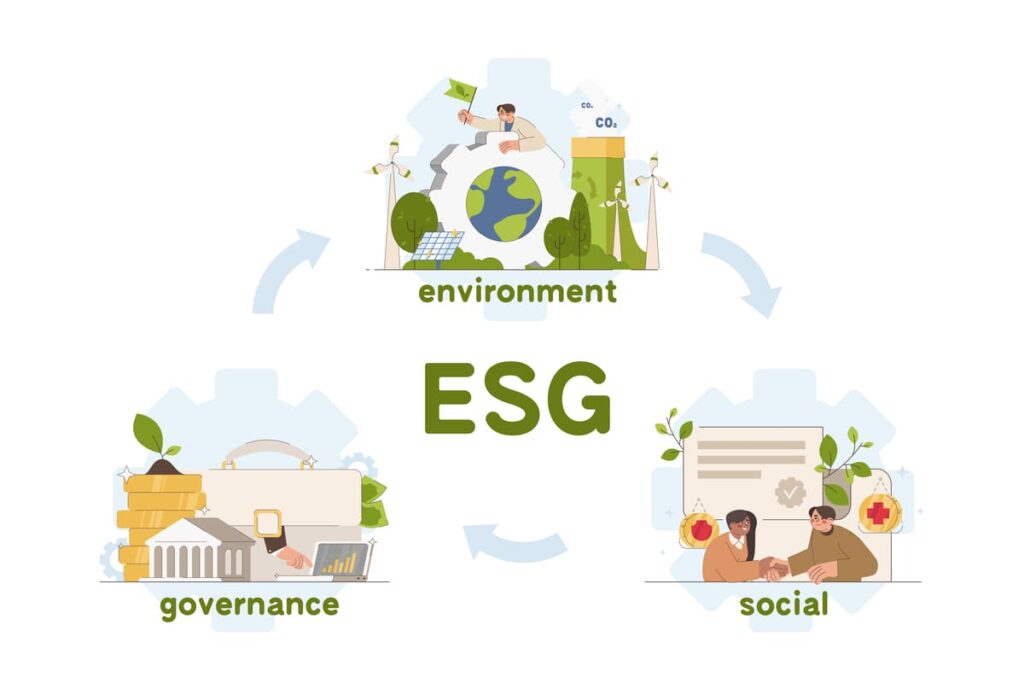
ESG in Construction – referring to Environmental, Social, and Governance practices in the building industry – is quickly shifting from voluntary initiative to a core compliance requirement. In the past, construction companies might have treated sustainability or social responsibility as “nice-to-have” extras or marketing points. But by 2025, a confluence of regulatory changes, market pressures, and stakeholder expectations around the globe mean that ESG is no longer optional. All types of construction businesses, from global contractors to local builders, now face concrete obligations to measure up on ESG criteria.
This article explains six key ways ESG in construction is becoming mandatory and, crucially, what firms must do in 2025 to adapt. We’ll break down the drivers – from government regulations and investor demands to client requirements – and provide practical guidance and real examples. The tone is objective and technical, as you’d find in an internal training manual, with clear explanations that make the concepts easy to understand.
Table of Contents
6 Ways ESG in Construction Is Becoming Mandatory: What Firms Must Do in 2025
Let’s dive into the six major forces making ESG compliance a must for the construction sector.
1. Government Regulations Are Forcing ESG Compliance
Governments worldwide are enacting laws and codes that effectively mandate ESG practices in construction. This is perhaps the most direct way ESG is becoming compulsory. Regulators are no longer content with voluntary corporate sustainability efforts – they are writing ESG principles into binding rules. These regulations span environmental, social, and governance aspects:
-
Climate and Sustainability Laws: Across the globe, new legislation requires companies to address climate impacts. For example, the European Union’s Corporate Sustainability Reporting Directive (CSRD) compels roughly 50,000 companies (including many construction and real estate firms) to publicly report detailed ESG metrics starting with 2025 reports. Similarly, many countries are introducing climate laws that align with the Paris Agreement, pushing construction projects to reduce carbon emissions and energy use. In the United States, several states and cities have enacted “Buy Clean” laws that require the use of low-carbon materials and reporting of the carbon footprint of construction materials (steel, cement, etc.) in public projects.
-
Building Codes and Permitting: Environmental standards are being baked into building regulations. Many jurisdictions have updated building codes to enforce sustainability – such as stringent energy efficiency requirements, insulation standards, and even mandates to include renewable energy or electric vehicle infrastructure in new developments. For instance, the Toronto Green Standard in Canada requires new developments to meet mandatory green building performance measures (Tier 1) as a condition of planning approval. In practice, if a developer or contractor doesn’t incorporate these sustainability criteria, they might not receive permits to build.
-
Social and Labor Regulations: ESG isn’t only about the environment. Governments are also enforcing the “S” and “G” pillars – Social and Governance – within construction. A clear example is the rise of modern slavery laws and labor standards. The UK Modern Slavery Act and Australia’s Modern Slavery Act both require large companies (which include many construction firms) to annually report how they are preventing forced labor and human trafficking in their operations and supply chains. Failing to demonstrate robust labor practices can lead to legal penalties and exclusion from government contracts.
-
Governance and Anti-Corruption: Construction has historically been prone to governance risks like bid-rigging or bribery, so governments are cracking down here too. Anti-corruption regulations (such as the US Foreign Corrupt Practices Act and the UK Bribery Act) impose heavy consequences on unethical practices. Public agencies increasingly require contractors to have compliance programs and ethical codes of conduct in place. In some jurisdictions, there is talk of mandating transparency in contracting and even board-level ESG oversight for companies over a certain size (for example, requiring companies to include climate risk oversight in their governance structure).
What firms must do: Construction companies need to stay ahead of these regulatory mandates. This means closely monitoring new laws and codes in every region they operate and ensuring full compliance. Companies should update their internal policies to align with emerging requirements – for example, establishing procedures to gather carbon footprint data of materials, training procurement teams on new “Buy Clean” rules, and enhancing health & safety programs. Many firms are creating dedicated ESG compliance teams or roles to oversee this.
A practical step is to develop a regulatory checklist for projects: before bidding or starting work, confirm that the project meets all relevant environmental codes (energy, emissions, waste) and labor regulations. By embedding compliance into project planning and design (rather than treating it as an afterthought), firms can avoid costly delays or legal issues. In short, regulation has made ESG a fundamental project requirement – much like structural or fire safety codes – and firms must treat it with the same level of diligence.

2. Mandatory ESG Reporting and Transparency Requirements
Another powerful way ESG is becoming mandatory is through formal reporting and disclosure requirements. Governments and financial regulators are forcing companies to publicly report their ESG performance, effectively making transparency non-negotiable:
-
ESG Disclosure Rules: In many regions, large companies (including big construction and engineering firms) are now obligated to produce annual sustainability reports following specific standards. The European Union’s CSRD is a prime example: it requires companies meeting certain size criteria to report on a wide range of ESG topics , with reports to be audited for accuracy. This goes beyond previous voluntary reporting – it’s a legal mandate, with fines for non-compliance. In the UK, climate-related financial disclosure aligned with TCFD has become mandatory for large companies and financial institutions, meaning firms must detail how climate risks could affect their business and projects.
-
Industry-Specific Metrics: These reporting requirements often include metrics highly relevant to construction. Companies may need to disclose their Scope 1, 2, and 3 emissions (including emissions from construction sites and supply chains), water usage on projects, waste and recycling rates, and even safety statistics (like accident rates) as part of the social performance disclosure. For example, a large contractor operating in the EU might have to report the total carbon emissions of its projects for the year, the percentage of construction waste it diverted from landfills, how many labor hours were lost to injuries, and how its board oversees ESG risks. This level of detail forces firms to have measurement systems in place.
-
Cascade to Smaller Firms: While the smallest construction companies might not be directly required by law to publish ESG reports, they are feeling the squeeze indirectly. Larger companies now under mandatory disclosure rules will expect their subcontractors and suppliers to provide ESG data so that the prime company can fulfill its own reporting obligations.
-
For instance, a major developer or general contractor assembling its annual sustainability report will likely ask each subcontractor for information on fuel usage, waste, or labor practices on their portion of a project. So even if you run a medium-sized specialty trade firm, don’t be surprised if you’re asked to track and report ESG metrics as part of doing business with bigger partners. Essentially, ESG reporting requirements trickle down the whole supply chain.
What firms must do: The writing is on the wall – every construction firm should establish a robust ESG data collection and reporting process. Concretely, companies should begin by identifying key ESG metrics relevant to their operations (e.g. fuel and electricity use on site, materials sourcing, workforce demographics, injury rates, etc.) and setting up a system (spreadsheets, software, or platforms) to gather this information consistently. It’s wise to align with established frameworks like GRI (Global Reporting Initiative) or ISSB standards for consistency. In practice, firms should train their project managers and site teams to record ESG data just as they record cost or schedule data.
For example, track diesel consumption of generators on a job, log how many tons of waste were recycled, document community complaints or incidents – these data points will feed into reports. Additionally, companies should get comfortable with external assurance or auditing of ESG data, since mandatory reports may require verification. A real-world example illustrates the importance of accurate ESG data: the Lawrence Berkeley National Laboratory (LBNL) in California implemented a centralized energy monitoring system across 26 campus buildings. In just two months, their facilities team discovered an unexpected issue – buildings were being heated and cooled at night when unoccupied, due to a misconfigured automation system.
By fixing this, they cut natural gas use by 50% in those buildings almost immediately. This example shows how closely tracking environmental data not only ensures compliance but also uncovers inefficiencies. The lesson for construction firms is clear: know your numbers. Whether it’s energy usage, carbon emissions, or safety performance, measure it and be ready to report it. Not only will this keep you on the right side of new regulations, it can also reveal cost savings and performance improvements.
Suggested article to read: Decarbonizing Construction; A Sustainable Future Ahead (2024 Solution)
3. Investor and Lender Pressure on ESG Performance
ESG is also becoming “mandatory” in construction through the influence of investors, banks, and insurance companies. In 2025, access to capital and financial services increasingly depends on a company’s ESG credentials. Financial stakeholders are effectively demanding ESG integration as a condition for doing business:
-
Investors’ Requirements: Large institutional investors, such as pension funds, asset managers, and private equity firms, are now scrutinizing ESG performance as part of their investment decisions. They view strong ESG practices as a proxy for good management and lower risk. In practice, this means a construction company seeking investment or even partnership may need to show its ESG track record. Many investors have committed to sustainable investing; for example, global investment firms have pledged to invest only in projects that align with net-zero emissions by 2050.
-
Banking and Financing Conditions: Banks and lenders are following a similar path. More than ever, lenders require borrowers to have ESG strategies and to provide ESG information when applying for loans or bonds. For instance, if a construction firm goes to a bank for a large project financing or to extend its credit line, the bank might ask: Do you have a climate risk assessment for this project? What’s your company’s carbon reduction plan? How do you manage safety and labor practices? We’re also seeing the rise of sustainability-linked loans – where the interest rate a company pays can go down if they meet certain ESG targets.
-
A real example: some construction companies have secured credit facilities where if they reduce their CO₂ emissions or improve their workforce diversity beyond a set benchmark, they get a slight interest rate discount, directly tying ESG performance to financial outcomes.
-
Global Sustainable Finance Initiatives: Internationally, frameworks like the EU Taxonomy for Sustainable Finance are shaping how capital flows into construction. The EU Taxonomy defines what counts as an environmentally sustainable activity (e.g. constructing energy-efficient buildings). If a project meets those criteria, it can attract green financing or qualify for green bonds; if not, it may be left out of certain investors’ portfolios. Therefore, construction firms that want to tap into the growing pool of green investment funds must align their projects with these ESG criteria or risk missing out on capital.
What firms must do: To maintain access to finance and insurance, construction firms should embed ESG into their financial and strategic planning. On a practical level, this involves a few key steps. First, engage with your investors and lenders on ESG topics – find out what metrics they care about and proactively share your progress. It could mean presenting your carbon reduction strategy during investor meetings or including safety and community engagement performance in your quarterly financial reports.
Second, consider setting formal ESG targets (like “reduce project CO₂ intensity by 30% in five years” or “achieve zero fatalities and reduce injury rate by X%”) and publicly commit to them; this signals to the financial community that you take ESG seriously. Third, prepare for due diligence: when negotiating loans or insurance, have documentation ready (ESG policies, past ESG reports, certifications like ISO 14001 environmental management or ISO 45001 safety management) to demonstrate your systems are sound. A tip is to get an ESG rating or score from a reputable agency – many investors look at third-party ESG ratings of companies.
If your company’s rating is low, that’s an early warning to improve governance or risk management. And remember, this pressure is not limited to public companies; even private, family-owned construction firms are finding that banks and clients are asking about ESG. By treating ESG performance as part of your company’s financial health, you’ll be better positioned to secure capital on good terms. Essentially, in 2025 the money flows to responsible builders, so make sure your ESG house is in order.
4. Client and Supply Chain Expectations in Construction
Beyond regulators and financiers, clients themselves are driving ESG requirements. Whether the client is a government agency, a large corporation, or a real estate developer, many are now insisting on strong ESG practices from their construction partners. This makes ESG effectively mandatory if you want to win contracts and stay in major supply chains:
-
Public Sector Procurement: Government clients, which account for a huge volume of construction work globally (from infrastructure projects to public buildings), are increasingly tying contract awards to ESG criteria. For instance, a city government might require bidders on a new transit project to present a sustainability plan detailing how they will minimize environmental impact (use of low-emission machinery, sourcing recycled materials, managing noise and dust to protect the community, etc.). If a contractor cannot demonstrate such measures, they might be disqualified.
-
Private Sector Clients: It’s not just governments. Large private developers and corporate clients also have their own sustainability and corporate responsibility goals, which flow down to their contractors. Take tech companies or global retailers building new facilities – many have pledged to construct green buildings (some even aim for all new buildings to be LEED-certified or equivalent). If you want to build their next office campus or distribution center, you’ll likely need to adhere to green building standards, use energy-efficient designs, and possibly even report on carbon emissions during construction.
-
Main Contractors and Supply Chain Pressure: The push goes down the tiers of the supply chain. Major construction managers and general contractors are asking their subcontractors and suppliers to prove their ESG credentials. For instance, a prime contractor on a large project may require all subcontractors to sign a code of conduct covering labor practices and environmental rules (proper waste disposal, no toxic runoffs). They might also ask subs to report data like fuel usage for equipment or to participate in recycling programs on site. Suppliers of materials (cement, steel, timber) are being asked for environmental product declarations (EPDs) and proof of sustainable sourcing.
What firms must do: To thrive in this environment, construction firms should treat ESG performance as key to their competitive advantage in bids and contracts. Here are practical steps to consider:
-
Build ESG into your proposals: When responding to RFPs (requests for proposal), always include an ESG section. Detail your company’s sustainability initiatives, any green building expertise, your safety record, how you engage with local communities, and so on. Provide concrete examples, like “X% of project waste diverted from landfill in a previous project” or “all site electricity from renewable sources via portable solar units”. This shows clients you can deliver on their ESG expectations. It’s wise to develop a standard ESG credentials document for your firm that can be attached to bids – this might list certifications (e.g., ISO 14001, LEED AP staff on team), key policies (safety, quality, ethics), and past achievements.
-
Comply with client codes and questionnaires: Many large clients now send out detailed ESG questionnaires or impose codes of conduct on suppliers. Take these seriously – assign someone to fill them accurately and highlight improvements. If a client’s supplier portal asks for your carbon footprint or diversity statistics, don’t ignore it; not providing data can exclude you. If you find gaps (e.g., you haven’t been tracking something they ask for), that’s a signal to start tracking it for the future.
-
Collaborate on ESG goals: Once on a project, work closely with the client and other contractors on joint ESG goals. If the project aims for a certain green certification or community hiring target, treat it as a project deliverable with a plan to achieve it. For example, schedule regular toolbox talks on environmental best practices for all crews, or partner with local job training programs to bring in apprentices – whatever helps meet the stated objectives. This not only helps fulfill requirements but also builds a positive reputation for your firm.
In essence, ESG has become a key selection criterion. Just as a client looks at your technical capability and price, they are now evaluating your environmental and social responsibility record. By proactively showcasing and improving your ESG performance, you increase your chances of winning work. In 2025’s market, the firms that can prove they build responsibly and ethically are the ones clinching the contracts.
5. Risk Management and Legal Liability Considerations
In the construction industry, ignoring ESG factors is no longer just a reputational issue – it’s a serious risk and liability concern. This is another driver making ESG indispensable: companies must consider ESG to manage risks, avoid lawsuits, and reduce insurance problems.
-
Project and Operational Risks: Construction projects inherently carry a lot of risk, and ESG issues amplify those. Environmental risks, for example, include pollution incidents (a chemical spill on a site) or violations of environmental permits (exceeding noise or dust limits, destroying protected habitat during site clearing). Such incidents can lead to regulatory fines, work stoppages, and costly remediation. If a company systematically neglects environmental precautions, it could face heavy penalties or have its projects shut down by regulators. Likewise, social risks like poor safety practices can result in accidents or even fatalities, which bring legal liability, higher insurance costs, and work delays.
-
Litigation and “Greenwashing” Liability: There’s a growing trend of legal challenges around ESG. One is climate litigation – communities and advocacy groups have begun suing companies (including those in high-emission sectors like construction and real estate) for their contribution to climate change or for failing to prepare for climate impacts. If a developer builds in a flood-prone area without climate resilience measures, and later properties are damaged by flooding, we might see lawsuits claiming the developer was negligent. Another emerging risk is liability for false or misleading sustainability claims, often called greenwashing lawsuits.
-
Insurance and Surety Requirements: Insurers and surety bond providers (who cover construction project risks) are increasingly factoring ESG into their assessment of companies. A contractor with frequent accidents or poor environmental management may be seen as a higher insurance risk, leading to higher premiums or difficulty obtaining coverage. Conversely, demonstrating strong ESG practices (like a robust safety program or climate risk plan) can make a firm a more attractive risk to insurers. In some cases, insurers have begun to ask companies about their climate adaptation measures.
-
For example, an insurer might ask if a coastal construction project has accounted for sea level rise or stronger storms in its design; if not, they may exclude certain damages from coverage. Surety bonds, which ensure a project’s completion, rely on the contractor’s overall stability – major ESG incidents (like a big environmental fine or a shutdown due to labor violations) could threaten that stability and therefore concern bond issuers. Thus, proactive ESG risk management is becoming necessary to secure the insurance and bonds that underpin project execution.
What firms must do: Integrating ESG into your overall risk management strategy is vital. Here’s how firms can respond:
-
Identify and Mitigate ESG Risks: Carry out risk assessments that include environmental and social factors. For each project, evaluate things like environmental sensitivities (are there wetlands, endangered species, or nearby communities affected by the work?), climate risks (heatwaves, storms, floods that could impact construction), and social risks (worker safety hazards, local community concerns). Then develop mitigation plans. For example, if building near a river, plan robust erosion control and emergency spill response; if working in extreme heat, have protocols for worker hydration and rest to prevent illness.
-
Strengthen Internal Controls and Training: Ensure that your company’s governance framework explicitly covers ESG. That means having clear policies (environmental policy, safety policy, ethics code) and training all employees on them. Regular training sessions on topics like environmental compliance, proper waste disposal, or anti-corruption can prevent costly mistakes. Many firms are appointing ESG officers or committees at the executive level to oversee these issues, which helps signal that it’s a priority and catches issues early. Strong internal controls and oversight can also help avoid any unwitting violations that lead to legal trouble.
- Accurate Reporting and Documentation: To avoid greenwashing claims, maintain thorough documentation of your ESG efforts and achievements. If you publish an ESG report or even a simple marketing brochure touting your sustainable construction, double-check that everything stated is factual and backed by data. It’s better to be modest and accurate in claims than to overstate and face backlash. For instance, if you claim “our project reduced carbon emissions by 40%,” ensure you have the calculations on file to prove it if questioned. Being transparent about both successes and challenges builds credibility and reduces legal risk.
By treating ESG factors as you would any other critical risk (like cost overruns or safety incidents), you create a safer, more resilient business. Firms that fail to do so may find themselves uninsurable, entangled in lawsuits, or simply uncompetitive. In short, good ESG risk management is good business management – it protects your company’s people, finances, and reputation.

6. Market Expectations and Competitive Necessity
The final way ESG in construction is becoming essentially mandatory is through market expectations and competitive pressure. As we reach 2025, doing nothing on ESG is not a viable option if a firm wants to remain credible and competitive. Industry leaders, employees, and the public are all raising the bar:
- Industry Leadership and Standards: Many leading construction and engineering firms have embraced ESG and are setting voluntary standards that quickly become industry norms. For example, major global contractors have announced targets to achieve net-zero emissions by 2040 or to divert 100% of construction waste from landfills. They are investing in electric construction equipment, innovating with low-carbon materials (like green concrete), and implementing advanced worker welfare programs. When big players do this, it creates pressure on everyone else – if your firm doesn’t keep up, it starts to look outdated or less responsible in comparison. Industry associations are also promoting ESG best practices, and awards or ratings highlight those who excel.
-
Talent and Workforce Expectations: The construction sector faces ongoing skilled labor shortages in many regions, and attracting new talent – especially younger professionals – has become a challenge. Here, ESG plays a surprisingly important role. The younger workforce is generally more attuned to values like sustainability, social impact, and corporate ethics. A construction firm with a strong ESG reputation (for instance, known for safety, community engagement, and environmental innovation) is more appealing to prospective employees. Conversely, companies with a poor reputation struggle to recruit and retain talent. In this way, having robust ESG practices becomes mandatory to maintain a strong team.
-
Public and Community Pressure: Construction projects often take place under the watchful eye of the public. Communities today are far more informed and vocal about environmental and social issues tied to construction. If a company tries to build a project that locals perceive as harmful – say it might increase pollution or displace residents without proper engagement – that company can face protests, delays, and even project cancellations. Gaining a social license to operate is crucial, and ESG is the framework that guides this. Companies effectively must engage in good ESG practices to avoid backlash. Moreover, end-users and buyers of buildings increasingly prefer sustainable properties.
What firms must do: Embrace ESG as a core part of your corporate identity and strategy – not just to satisfy others, but to sharpen your competitive edge. Here are some practical moves:
- Innovate and lead: Try adopting at least one or two visible ESG initiatives that set your firm apart. For example, pilot the use of clean technologies on your sites (like solar-powered site offices or electric cranes) or adopt a new sustainable construction method (such as modular construction to reduce waste). Real-world success stories spread quickly – if you can claim that “we built the first net-zero energy school in our region” or “we retrofitted equipment to cut emissions by 30%,” it builds your brand as an innovator. Innovation also often brings efficiency gains: many sustainable practices can reduce costs in the long run.
- Communicate transparently: Share your ESG progress publicly – through annual sustainability reports, your website, or case studies. This isn’t about bragging; it’s about demonstrating accountability. When clients or partners search for your company, they should easily find information on what you’re doing about ESG. Highlight concrete results (e.g., “In 2024, we reduced our CO₂ emissions by X tons and had zero serious safety incidents”) and also be honest about goals and challenges. Transparency builds trust with all stakeholders, from investors to local communities. It shows that you have nothing to hide and are serious about continual improvement.
- Integrate ESG into quality and strategy: Treat ESG goals as part of your business targets, on equal footing with financial goals. Many firms now include sustainability and safety metrics in their key performance indicators (KPIs) and executive bonuses, which ensures leadership focus. Strategic planning sessions should incorporate ESG trends: for instance, if you foresee that in five years all clients will demand carbon-neutral buildings, start developing expertise in that area now. By aligning your business strategy with ESG trends, you are effectively future-proofing your company.
In summary, ESG competence has become a hallmark of leading construction firms. It’s increasingly expected by everyone that matters: clients, partners, employees, and society at large. Those companies that authentically embrace ESG stand to enhance their reputation, attract better opportunities, and mitigate risks – giving them a decisive advantage. In 2025, doing good (for the environment, workers, and society) is directly tied to doing well as a business. ESG in construction has moved from a secondary concern to a central criterion for success.
FAQs
How are construction companies affected by new ESG regulations in 2025?
Construction companies are increasingly subject to regulations that require them to address ESG factors. For example, new laws might require large construction firms to report their carbon emissions and climate risks annually. Building codes are adding sustainability requirements (like energy efficiency standards), and laws around labor practices (such as modern slavery reporting) are holding companies accountable for their social impact. In 2025, a construction company may need to comply with these rules to get permits, win public contracts, or avoid fines, so ESG compliance has become a regular part of doing business.
What ESG standards or frameworks do construction firms have to follow?
Many construction firms align with ESG reporting standards such as GRI (Global Reporting Initiative) or the new ISSB (International Sustainability Standards Board) guidelines for sustainability disclosures. In the EU, construction companies may follow the European Sustainability Reporting Standards under CSRD for mandatory reporting. In the UK and other regions, companies are adopting TCFD (Task Force on Climate-related Financial Disclosures) guidelines for reporting climate risks. Additionally, construction-specific programs like LEED or BREEAM (for green buildings) and ISO certifications (e.g., ISO 14001 for environmental management, ISO 45001 for safety) provide frameworks to manage and demonstrate ESG performance on projects.
Which ESG factors are most important in the construction industry?
Key ESG factors for construction often include: Environmental – energy use and carbon emissions of projects, materials sustainability (like use of recycled or low-carbon materials), waste management and recycling, and impact on local ecology. Social – health and safety performance (accident rates on sites), labor practices (fair wages, worker training, diversity and inclusion in the workforce), and community engagement (managing noise, dust, and addressing community concerns). Governance – business ethics and compliance (anti-corruption measures in procurement), transparency in reporting project impacts, and having clear oversight of ESG at the leadership level. These factors are important because they relate directly to the risks and responsibilities inherent in construction projects.
Is ESG reporting now mandatory for construction companies or just voluntary?
It depends on the company’s size and location, but ESG reporting is increasingly becoming mandatory for many construction companies. In the European Union, as of 2025, even privately held medium- and large-sized companies must report on sustainability policies and performance (this comes from the CSRD mandate). In the UK, large companies have mandatory climate-risk disclosure requirements. Some jurisdictions like California have laws coming into effect that require big companies (including construction firms above certain revenue thresholds) to disclose their greenhouse gas emissions.
While smaller construction firms might not be legally forced to publish ESG reports yet, they often do so voluntarily or provide data to their larger partners. Moreover, clients and investors frequently request ESG information regardless of legal mandates. So in practice, most prominent construction firms now treat ESG reporting as a necessity, not just an optional exercise, to meet stakeholder expectations and comply with emerging rules.
Conclusion
In 2025, ESG in construction is no longer just a buzzword – it’s becoming a baseline requirement across the industry. We’ve seen six major forces making this happen: government regulations imposing sustainability and social standards, mandatory reporting rules demanding transparency, investors and banks linking financing to ESG performance, clients and contractors pushing ESG through the supply chain, risk and liability factors necessitating proactive ESG management, and overall market expectations raising the bar for everyone. Together, these forces mean that construction firms of all sizes, in all regions, must integrate ESG considerations into their core operations and strategy.
For construction companies, the mandate is clear: adapt and embed ESG now, or risk being left behind. This doesn’t just mean avoiding penalties or ticking boxes – it also presents an opportunity. Firms that proactively embrace ESG can improve efficiency (like reducing energy waste), enhance their brand and relationships, and gain a competitive edge in bidding and talent recruitment. As ESG principles become more tailored to construction’s realities, every participant – from contractors to material suppliers – is expected to contribute to sustainability and ethical practices.
Investors and clients will continue to expect transparent, responsible conduct from all involved in projects. Acting responsibly is not only the right thing to do for people and planet, but it is also the smart path for long-term business success in construction. In short, ESG is becoming mandatory, but those who champion it will find themselves better prepared for the future of this industry.
Resources:
-
Pulsora. Courtney Grace. (2025). ESG reporting requirements by industry for 2025.
-
Daily Commercial News (ConstructConnect). John Bleasby. (2025). ESG in construction hasn’t stalled, it’s shifting gears.
-
Bluebeam Built Blog. Diana Kightlinger. (2024). Unlocking ESG for Builders: A Practical Guide to Compliance, Profitability and Brand Value.
-
Prostream. Demi-Jo Smith. (2023). What is an ESG report and what does it mean for your construction company?
-
McMillan LLP. (2021). Evidence of ESG in the Construction and Development Industry.
For all the pictures: Freepik
Suggested article for reading:
4 Field-to-Office Workflows Transformed by Modern Construction Management Software
11 Quick Compliance Checks for Public Construction Tenders (Avoid Disqualification)
6 Construction Tender AI Tools That Speed Up Your Responses (Save Time, Improve Accuracy)
10 High-Value Public Construction Tenders to Watch This Quarter (Opportunities & How to Bid)
4 Steps to Build a Tendering Playbook for SMEs (Win More Construction Tenders Without a Bid Team)