
Ultrasonic leak detectors are becoming indispensable tools on modern construction sites and industrial facilities. These devices use high-frequency sound waves to pinpoint leaks in compressed air lines, gas pipelines, vacuum systems, and more – leaks that might otherwise go unnoticed until they cause serious safety hazards or costly losses. In construction and maintenance, catching a leak early can prevent accidents (like fires or equipment failures), avoid energy waste, and keep projects on schedule. In fact, studies show that undetected air leaks can account for up to 30–40% of a system’s energy consumption, so finding and fixing them quickly is critical for both safety and efficiency.
This article will explain how ultrasonic leak detectors work and why they matter for construction safety. It will then highlight five leading ultrasonic leak detector technologies that are making big waves in the industry. Each example will include real-world insights and practical applications, showing how these tools help create safer and more efficient construction environments.
Table of Contents
Understanding Ultrasonic Leak Detectors
An ultrasonic leak detector is a specialized device designed to “hear” the high-frequency sound produced by a leak. When pressurized fluid (like air or gas) escapes through a small crack or hole, it creates turbulent flow. This turbulence generates sound in the ultrasonic range (typically above 20 kHz, beyond human hearing). Ultrasonic leak detectors have sensitive microphones or sensors tuned to these frequencies. They convert the inaudible sound into signals or audible tones that technicians can use to pinpoint the leak’s location.
Key characteristics of ultrasonic leak detection include:
-
Directional sensing: Ultrasonic signals are very short-wavelength and directional. The noise from a leak will be strongest at the source and drop off quickly with distance. Detectors use this property to guide users toward the leak. Many units have a directional microphone or even a laser pointer to help aim at the source.
-
Noise filtering: Construction sites can be noisy, but ultrasonic detectors can filter out lower-frequency background noise (machinery, voices, etc.) and focus only on the high-frequency “hiss” of leaks. This makes them effective even in loud environments where an audible leak might be masked.
-
Non-invasive: Using an ultrasonic leak detector is non-destructive – there’s no need to shut down equipment or open up walls/pipes just to find a leak. The detector can scan from the outside, which is safer and faster for routine inspections.
In practice, an inspector sweeps the device around valves, joints, fittings, or equipment where leaks might occur. The detector typically outputs a sound (often via headphones) that gets louder or a meter reading that increases as the sensor gets closer to the leak. Modern detectors often also provide a visual indicator or even an image (more on that later). By methodically scanning and following the strongest signal, the exact leak spot can be located and marked for repair.
Why Ultrasonic Leak Detection Improves Safety and Efficiency
Leakages on construction projects or industrial facilities pose multiple problems. First and foremost, safety is a concern: a leaking fuel gas line could lead to a fire or explosion, and escaping oxygen or chemicals can create health hazards. Even something as simple as a compressed air leak can cause dangerous situations – for example, a burst air hose whipping around under pressure can injure workers. Ultrasonic leak detectors help crews find these issues early before they escalate into accidents.
Secondly, leaks are synonymous with waste and inefficiency. A steady hiss of compressed air from a faulty coupling might seem minor, but over time it forces compressors to run longer and harder, consuming more electricity. Even small leaks can cost thousands of dollars in wasted energy annually. In one instance, maintenance personnel discovered that a combination of small air leaks was bleeding off enough compressed air to cost over $100,000 per year in electricity – a loss that went unnoticed until an ultrasonic survey revealed the extent.
By fixing leaks identified with ultrasonic detectors, companies can save significant costs on energy and materials. Some facilities have reported reducing their compressed air energy usage by about 30% after implementing routine ultrasonic leak inspections – a huge win for both the budget and the environment.
Finally, using these detectors supports better preventive maintenance. Rather than reacting to problems (like a machine failing due to lack of pressure or a pipeline alarm going off), teams actively hunt for early warning signs. For example, a construction team might use an ultrasonic leak detector to check all pneumatic tool lines and gas hoses at the end of each week. This proactive approach means fewer surprises: equipment runs more reliably, and the worksite stays safer. It also helps in meeting safety regulations, as many occupational safety standards require regular inspection of gas systems and prevention of hazardous releases.
With the importance established, let’s look at five ultrasonic leak detector solutions that are making a significant impact in construction safety and maintenance.
Suggested article to read: 4 Important Tips for Building Maintenance
5 Ultrasonic Leak Detectors Making Big Waves in Construction Safety
1. Fluke ii900 Sonic Industrial Imager (Acoustic Camera for Leaks)
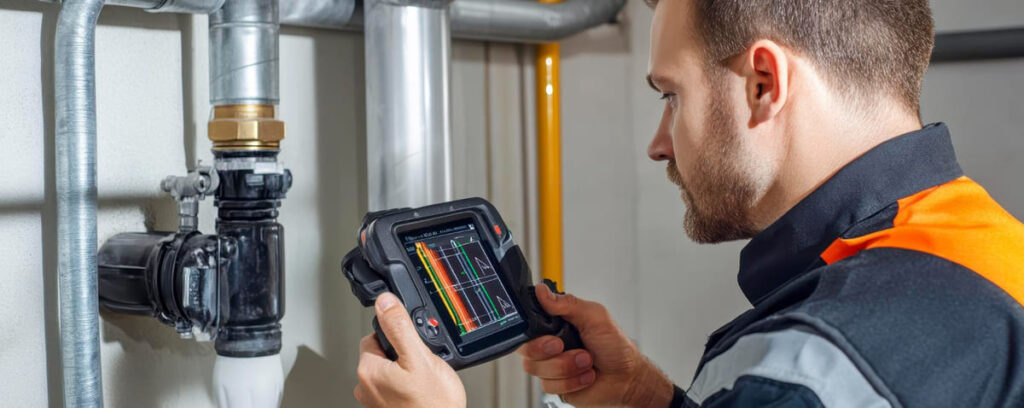
One of the most groundbreaking developments in leak detection is the use of acoustic imaging cameras. The Fluke ii900 Sonic Industrial Imager is a prime example that has quickly gained popularity in construction and industrial maintenance. Unlike traditional detectors that rely only on sound, the ii900 combines an array of ultrasonic microphones with a visual camera. It produces a live “sound map” overlaid on a visible image of the area, essentially showing you exactly where a leak is occurring – almost like thermal imaging but for sound.
Real-world example: Mediclinic International, a large hospital group operating facilities across several countries, adopted the Fluke ii900 to improve safety and reduce waste. In their hospitals, various medical gases (oxygen, nitrous oxide, etc.) are piped through the building. Leaks not only wasted expensive gases but also posed risks to patients and staff. Using the acoustic imager, maintenance staff were able to scan entire gas pipe runs quickly from a safe distance (the ii900 can detect leaks up to about 50 meters away).
They immediately “saw” bright spots on the device’s screen indicating several hidden leaks in pipe joints that had been missed by traditional methods. By repairing those leaks, the hospital improved patient safety (no more oxygen seeping into areas it shouldn’t) and significantly reduced gas losses and costs. The team noted that even non-specialists could use the tool effectively with minimal training, thanks to the intuitive visual guidance.
Notable features (Fluke ii900): Key Features of the Fluke ii900 Acoustic Imager:
-
Visual Leak Location: Displays a color SoundMap™ on a 7-inch screen, pinpointing leak sources in real time.
-
Long Detection Range: Can scan large areas and find leaks up to 50 m (about 164 ft) away, allowing safe checking of high ceilings or dangerous areas from the ground.
-
Frequency Tuning: Isolates the specific ultrasonic frequencies of leaks, filtering out background noise even in a loud factory or construction site.
-
High Precision & Speed: Dozens of built-in microphones enable scanning an entire facility quickly – what used to take days with a handheld sniffer can be done in hours.
-
Image & Data Capture: Takes photos or even videos with leak indicators. Each leak image can display the estimated leak rate and cost, helping prioritize repairs. The data can be saved for reports or analysis.
In construction settings, the Fluke ii900 is extremely useful for checking compressed air systems (like the ones powering pneumatic tools), gas lines for temporary heaters, or even plumbing and steam systems in industrial projects. By quickly visualizing leaks, it helps safety engineers and maintenance crews collaborate – they can literally point at a live image and decide on a fix immediately. This technology exemplifies how ultrasonic leak detection has evolved to become more user-friendly and powerful, making a big impact on safety programs.
2. UE Systems Ultraprobe 15000 (Ultrasonic Inspection System)
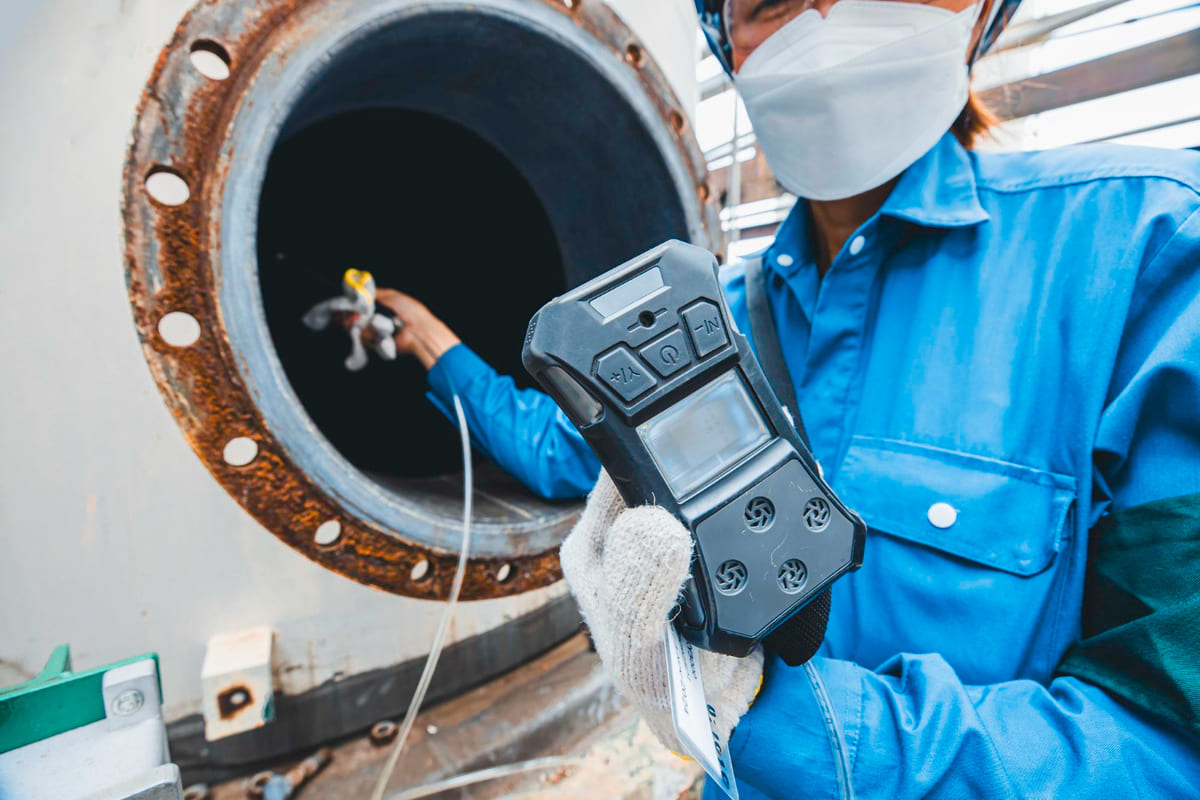
UE Systems is a pioneer in the field of ultrasonic inspection, and their Ultraprobe series has been a staple in industrial maintenance for decades. The Ultraprobe 15000 is their latest flagship ultrasonic leak detector (often called an ultrasonic inspection system because it does more than just leak find). It’s a handheld device shaped like a pistol, packed with advanced sensors and even a camera and touchscreen interface.
What makes the Ultraprobe 15000 stand out is its focus on predictive maintenance and data. It not only allows technicians to hear and locate leaks, but also to quantify and document them. The device can measure sound intensity and even estimate the leak flow rate when used with the right attachments, giving an idea of how severe a leak is. It has on-board memory and Wi-Fi connectivity to sync all the readings and even photos of the leak location to software for analysis.
From a construction safety perspective, the Ultraprobe is like a multi-tool: it can check for compressed air and gas leaks, inspect steam traps, listen for electrical discharge (to prevent fires from faulty electrical gear), and even help with bearing inspections on heavy machinery. This versatility is great on construction sites where various systems need monitoring but budgets might only allow for one high-quality instrument.
Practical example: A manufacturing plant attached to a construction project (for instance, a site that produces prefab components) started a reliability program using the Ultraprobe 15000. Technicians performed regular “ultrasound audits” of the compressed air network that ran tools and machines. The first audit with the Ultraprobe revealed over 20 leaks ranging from tiny valve hiss to a larger pipe joint leak.
By repairing those, the plant immediately saw energy consumption drop and pressure stability improve (tools that previously suffered pressure drops started operating consistently, improving product quality). The Ultraprobe’s built-in camera allowed the team to take a picture of each leak spot and generate a professional report, which management used to schedule targeted repairs. The device’s data logging also made it easy to track if any repaired leak starts leaking again, thereby improving long-term safety and maintenance planning.
Notable features (UE Systems Ultraprobe 15000):
-
Touchscreen & Camera: The Ultraprobe 15000 includes a full-color touchscreen for navigating menus and reviewing data on the go. It also has a built-in high-resolution camera with flash, so you can photograph the component or area where a leak or fault is detected and attach that image to the record.
-
Multi-Mode Detection: It supports airborne ultrasound detection (for finding leaks in air, gas, vacuum systems) and structure-borne ultrasound via contact probes (for listening to internal machinery noises, like bearing friction or valve chatter).
-
Data Sync and Wi-Fi: Uniquely, this detector can sync via Wi-Fi to a computer or cloud database. That means all readings, audio recordings, and images can be uploaded instantly to analysis software or a maintenance management system, without manual data entry.
-
Analysis Software Integration: UE Systems provides software that helps estimate leak costs, manage inspection routes, and even trend the condition of equipment over time. This transforms leak detection from a one-time event into a continuous improvement process.
-
Rugged and Reliable: Designed for industrial environments, the unit is robust and comes with various attachments (long-range sensors, flexible wands, etc.) to get into tight or hard-to-reach areas. Its manufacturer emphasizes that using the Ultraprobe is an integral part of a plant’s safety and reliability program – underscoring how detecting leaks can prevent both energy losses and potential safety incidents (like catching a failing steam trap before it blows or a bearing before it overheats).
For construction safety, a tool like the Ultraprobe 15000 ensures that both common leaks and other hidden issues are detected early. By using such technology, construction firms can comply with safety regulations (for instance, checking that no combustible gas is seeping from temporary fuel lines) and also promote a culture of preventative maintenance on site.
3. MSA Gassonic Observer-i (Fixed Ultrasonic Gas Leak Detector)
Not all ultrasonic leak detectors are handheld or used for periodic inspections – some are installed as continuous monitors for critical safety. The MSA Gassonic Observer-i is a fixed ultrasonic gas leak detector often found in heavy industrial and energy facilities, and it’s making its way into large construction projects especially in the oil & gas and chemical sectors. This device essentially “listens” 24/7 for the sound of gas leaks in a given area and triggers an alarm if a leak is detected.
What sets the Observer-i apart is its use of Artificial Neural Network (ANN) technology (a form of AI) to distinguish between real gas leak sounds and other ultrasonic noise. Construction and industrial sites can have lots of ultrasonic noise from machinery, but the Observer-i’s intelligent processing filters out benign sounds. When pressurized gas leaks out (for example, from a pipe flange or a hose at 150 psi), the device recognizes the acoustic pattern almost instantly (literally at the speed of sound).
This is crucial for safety: unlike traditional gas detectors that require the gas to diffuse to a sensor, an ultrasonic detector like the Observer-i doesn’t depend on the gas reaching it – it only needs to “hear” it. This means even outdoors or in ventilated areas, it can catch a high-pressure gas leak within seconds, giving an early warning before gas accumulates to dangerous levels.
Usage scenario: Imagine a large construction site building an LNG plant or a petrochemical facility. During both construction and commissioning, there are miles of new gas piping. Traditional gas detectors are placed, but they might not sense a jet of gas if wind blows it away. So the project installs several Observer-i units around high-risk zones. One day, a flange gasket on a high-pressure natural gas line starts leaking with a faint hiss.
Immediately, the Observer-i covering that zone detects the ultrasonic signature and raises an alarm in the control room. Work is halted and the crew fixes the flange before any ignition source creates an incident. In this case, the ultrasonic detector potentially averted a major accident, as the leak was found before anyone even smelled gas or standard sensors picked it up. This illustrates why these devices are highly valued in safety-critical construction projects.
Key characteristics (MSA Gassonic Observer-i):
-
Instant Detection: Reacts to the sound of a gas leak in milliseconds, effectively providing an alarm in real-time as the leak starts. This high speed is vital for safety systems.
-
ANN Signal Processing: The built-in artificial neural network is “trained” on what real leak sounds look like versus noise (like rotating machinery, vent valves, etc.). This yields excellent false-alarm rejection – it only alarms for genuine leaks. The Observer-i can even handle very noisy environments and still detect small leaks up to about 28 meters (90+ feet) away.
-
No Calibration Drift: It does not need constant recalibration to account for environmental changes. Traditional gas sensors might need adjustments for temperature or replaced sensor cells; an ultrasonic detector just needs its microphone to be unobstructed. The Observer-i even performs an automatic self-test on its microphone every 15 minutes to ensure it’s functioning optimally.
-
Weatherproof and Hazard-Rated: Designed to be permanently mounted outdoors, it’s built to withstand harsh weather and is certified for hazardous areas (explosion-proof housing, etc.). This is important for construction sites that turn into operating plants.
-
Integration with Safety Systems: It outputs standard signals (like 4-20 mA, HART, or Modbus digital communication) so it can tie into the site’s alarm panel or building management system. If a leak is detected, it can trigger visual alarms, sirens, and even automatic shutdown procedures.
While the Observer-i is more of a fixed safety instrument than a portable tool, it represents a crucial use of ultrasonic leak detection for safety monitoring. Its presence in our list underscores that ultrasonic technology is not just for maintenance efficiency – it’s also about saving lives by detecting dangerous leaks in time. Construction projects that involve hazardous gases would do well to include such detectors as part of their overall safety design.

4. Synergys LeakShooter LKS1000 (Ultrasonic Leak Detection Camera)
The Synergys Technologies LeakShooter LKS1000 – often just called “LeakShooter” – is another innovative ultrasonic leak detector that has been making waves, especially in maintenance circles. It’s a handheld device that, true to its name, helps you “shoot” (locate) leaks using an on-screen target. Think of it as a cross between a video game and a maintenance tool: you point the LeakShooter in different directions, and when it detects a leak, a target or crosshair appears on its display, guiding you toward the source. The closer you get, the more centered or intense the target indicator becomes, allowing rapid pinpointing of the leak.
What’s notable about newer versions like the LKS1000-V2+ and V3+ is that they combine high sensitivity with visual output. They also introduced some features unique in the industry, such as an integrated thermal camera on the V3+ model to help diagnose steam traps (a steam trap that’s failed open will show cold downstream, etc., complementing the ultrasonic findings).
Practical benefit example: A building facilities team was facing unusually high steam usage in one of their plants under construction. They suspected some steam traps (which purge condensate from steam lines) were leaking or failed. Using the LeakShooter, they conducted a survey of dozens of steam traps and air lines. The LeakShooter’s visual targeting allowed even a relatively new technician to quickly spot trap #15 was blowing through (ultrasound picked up the turbulent flow inside it).
Additionally, because the premium model had a built-in infrared camera, the tech could confirm on the screen that that trap was cool (meaning steam was not being held back as it should). The device captured images of each suspect trap with measurements. Thanks to this, the team replaced several faulty traps and insulated a few valves better. In the first month after repairs, the facility’s steam consumption dropped noticeably – translating to energy savings and a safer system (no more hot condensate leaking into work areas). The visual evidence the LeakShooter provided made it easy to convince management where the issues were and take action.
Key features of the LeakShooter LKS1000 series:
-
High Sensitivity Detection: The LeakShooter can detect extremely small leaks (pinhole-sized) from up to 20 meters away. Covering a large room (e.g., a 13,000 sq.ft. warehouse) is feasible by scanning from the center, which is very efficient.
-
On-Screen Guidance: It uses dynamic on-screen icons (like a target or arrow) to guide the user toward the leak. This real-time feedback shortens the learning curve – maintenance staff have described it as almost like using a metal detector, but for air leaks.
-
Leak Quantification: The device calculates and displays the estimated leak rate and even a “LeakScore” or cost estimate. For instance, it might show that a detected leak is losing 3 cubic meters of air per hour, costing $500 annually. This quantification helps prioritize fixes by showing which leaks are most costly.
-
Image Capture and Reporting: Every detected leak can be photographed with the built-in camera, and the leak info (dB level, leak rate, cost, time stamp) is overlaid on the image. Up to thousands of these images can be stored and later transferred to a computer. This is immensely helpful for creating repair work orders or an audit trail of repairs completed.
-
Steam Trap Mode (V3+ model): With the integrated thermal imaging on the higher model, the LeakShooter becomes a dual tool – it can both listen for a leaking trap and visualize its temperature. Specialized software (StrapShooter) can use those readings to assess if a steam trap is operational or failed. This combination addresses a key safety and energy issue in many plants: failed steam traps can cause explosions (if pressure builds) or waste a lot of energy.
On construction projects that involve complex building systems, the LeakShooter is a great commissioning and maintenance device. For example, during a building commissioning, the HVAC contractor can use it to check all the ductwork and pneumatics for leaks, ensuring the system operates at peak efficiency from day one. It’s also useful for checking the seals of windows and doors (by using an ultrasonic tone generator inside a room and scanning from outside – the detector will find where ultrasound leaks out of the building envelope, indicating poor seals).
This makes the LeakShooter quite versatile, bridging pure safety (preventing hazardous leaks) and quality (assuring building tightness and energy efficiency). Its user-friendly design is encouraging more frequent leak inspections, which ultimately results in safer workplaces.
5. Sonotec SONAPHONE (Digital Ultrasonic Testing Device)
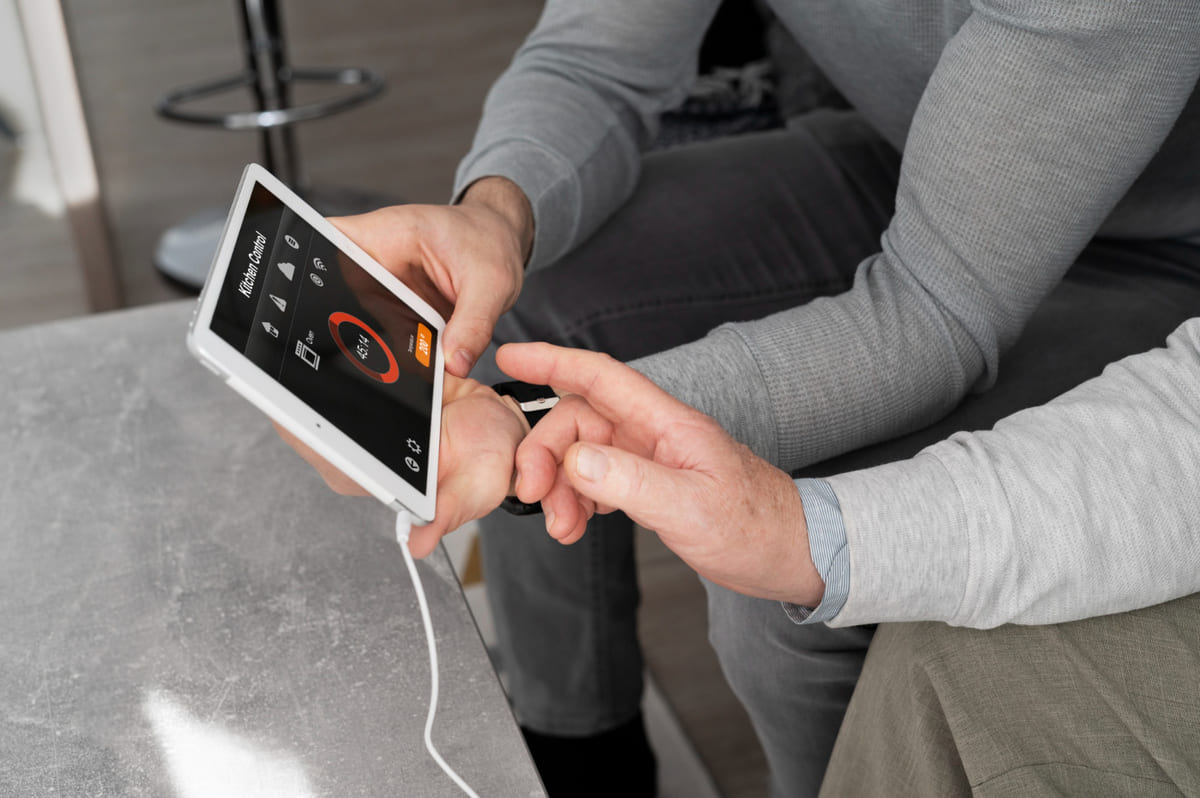
The SONAPHONE by Sonotec is a modern ultrasonic leak detector that embodies the concept of Maintenance 4.0 (bringing digital technology into maintenance tasks). At first glance, the Sonaphone looks like a small tablet or advanced smartphone. It has a touchscreen interface and connects to various ultrasonic sensors (airborne and structure-borne). The idea is to have a single device that can guide users through different maintenance tasks – leak detection, electrical inspection, bearing monitoring, etc. – with the help of apps and software.
For leak detection specifically, SONAPHONE offers a dedicated app called LeakExpert that runs on the device. When a technician is out in the field, the app provides step-by-step guidance: it can show where to scan, how to adjust sensitivity, and even allow input of details like pressure so it can estimate the leak’s cost impact on the spot. Because it’s digital, it simultaneously records the sound data, takes pictures, and lets the user classify the leak (e.g., “pipe fitting in compressor room”) all on the device.
After the inspection, the data can be synced to a PC where comprehensive reports are generated. This level of documentation can be extremely useful for construction project handovers – the maintenance team can prove that the facility was delivered with no known leaks, or provide a list of issues to fix.
Example in practice: Consider a facilities management team responsible for a large office complex. They implemented an energy savings program that included routine ultrasonic leak inspections. Using the SONAPHONE, an engineer did a round of the complex’s mechanical floors. The device’s LeakExpert app helped by showing a checklist of all compressors and pipe lines to inspect (since they had set up an inspection route in the software). During the survey, the SONAPHONE detected several leaks: one in a compressed air line feeding the elevators’ machine room and two small leaks in the HVAC chiller plant.
Each time, it recorded sound samples and the engineer used the tablet screen to capture a photo of the component. The device automatically calculated that these leaks were costing about 10% extra energy on the air system. After repairs (a loose valve packing tightened and a cracked pneumatic hose replaced), the subsequent month’s energy records showed a noticeable drop in electricity consumption. Over a year, the complex saved a substantial amount on utility bills. Just as important, critical equipment like the elevator and chiller had less strain (since pressure was now stable), improving their reliability and safety for occupants. The SONAPHONE’s detailed digital reports made it easy for management to see the before-and-after and justify the maintenance work.
Highlights of Sonotec SONAPHONE:
-
Multi-function Tablet Form: It’s essentially an all-in-one ultrasonic testing device with a 5-inch touchscreen. The interface is user-friendly, with intuitive menus and even training materials accessible on the device. This lowers the barrier for technicians to effectively use ultrasonic inspection technology.
-
Broadband Ultrasound and Sensors: The SONAPHONE can detect frequencies from 20 kHz up to 100 kHz using specialized sensors. This wide range means it can catch very subtle leaks or electrical discharges that emit higher frequencies. Sonotec provides different sensor attachments: an airborne sensor for general leak detection, a parabolic sensor for detecting leaks from a longer distance (up to ~35 m), and contact sensors for mechanical analysis.
-
Smart Apps and Data Handling: What really shines is the software ecosystem. Apps like LeakExpert (for leaks), SteamExpert (for steam trap testing), and Lubrication (for guiding bearing greasing) turn the device into a tutor. They help standardize how inspections are done and ensure no steps are missed. The data from inspections is stored with timestamps and can include audio recordings and pictures. The SONAPHONE DataSuite software on PC then aggregates all this data, allowing analysis of trends (e.g., which section of piping is leaking frequently) and automatic report generation.
-
Preventive Maintenance Integration: Because the SONAPHONE encourages regular data collection, it fits well in an ISO 50001 energy management or any preventive maintenance plan. It essentially provides the evidence of checks being performed. This can be important in construction safety compliance – for instance, a safety auditor can be shown logs from SONAPHONE inspections as proof that gas lines or compressed air systems were routinely checked for leaks and issues.
-
Tightness Testing capability: Apart from finding leaks in pressurized systems, SONAPHONE can also be used for tightness testing of enclosures. With an ultrasonic transmitter placed inside a room or container, the SONAPHONE can scan from outside to detect any ultrasound escaping through gaps. This is extremely useful for checking the airtightness of fire doors, window installations, or even vehicle cabins. For construction, this means better quality control of building seals and insulation, contributing to both safety (smoke or gas can’t leak from one area to another in case of fire) and energy efficiency (less conditioned air leakage).
The SONAPHONE shows how ultrasonic leak detection is embracing digital transformation. By making the tool interactive and data-rich, it not only finds leaks but also helps manage the whole process of fixing them and improving systems. In construction and facility management, this leads to a more educational, proactive approach – teams learn from each inspection, and the building or plant continually gets safer and more efficient.
FAQs
How does an ultrasonic leak detector work?
Answer: An ultrasonic leak detector works by listening for the high-frequency sound (ultrasound) produced by a leak. Turbulent gas or air escaping from a pressurized system creates ultrasonic noise. The detector’s sensitive microphone picks up these sound waves, then converts and amplifies them into signals or sounds that a human can interpret. In practice, you scan the device around pipes, fittings, or equipment; the closer you get to the leak source, the stronger the ultrasonic signal, allowing you to pinpoint the exact location of the leak.
What types of leaks can ultrasonic detectors find?
Answer: Ultrasonic detectors can find any leak that generates turbulent flow and ultrasound. Common examples include compressed air leaks, pressurized gas leaks (like natural gas or oxygen lines), vacuum leaks (air rushing into a vacuum system), and even steam leaks or refrigerant leaks through small orifices. They are versatile – used for everything from finding air leaks in pneumatic tools and hoses, to detecting leaks in valves, pipe fittings, steam traps, and even checking for window or door seal leaks using a sound source.
Which ultrasonic leak detector is best for construction site use?
Answer: The best ultrasonic leak detector for a construction site depends on the specific needs. For general purpose use and routine inspections, a portable handheld detector (like the UE Systems Ultraprobe or Sonotec Sonaphone) is a great choice because it’s versatile and can detect various types of leaks on-site. If you need to scan large areas quickly or from a safe distance (for example, checking high-altitude pipelines or across noisy areas), an acoustic imaging camera such as the Fluke ii900 can be very effective.
In hazardous environments where continuous monitoring is critical (like a site dealing with pressurized fuel gases), a fixed ultrasonic gas leak detector (such as the MSA Gassonic Observer-i) might be the best option for safety. Often, construction projects use a combination: handheld units for regular maintenance checks and fixed units for critical safety monitoring.
Is it true that using ultrasonic leak detectors can save energy costs?
Answer: Yes, absolutely. Many companies find that using ultrasonic leak detectors translates directly into energy savings. By finding and fixing leaks in compressed air lines, steam systems, or other pressurized utilities, you eliminate waste. Even a small air leak can bleed off a lot of compressed air over time, forcing compressors to run longer (which uses more electricity). Ultrasonic detectors help identify these hidden losses. Real-world results have shown energy cost reductions on the order of 10–30% for compressed air systems after a thorough leak detection and repair campaign. In addition to energy cost savings, you’ll also reduce wear on equipment (since machines aren’t overworking to compensate for leaks), which can lower maintenance costs too.
Conclusion
Ultrasonic leak detectors have proven to be game-changers in construction safety and maintenance. By “hearing” what human ears cannot, they allow us to find hidden problems – from a compressed air leak costing a fortune in energy, to a gas leak that could endanger lives – and fix them before they escalate. The five technologies highlighted above exemplify the range of solutions available: from advanced imaging cameras that visualize sound, to handheld multi-tools that log data, to fixed monitors that guard against catastrophic gas releases. Each plays a role in making construction sites and industrial facilities safer, more efficient, and more environmentally friendly.
The common thread is that investing in these ultrasonic leak detection tools leads to a proactive safety culture. Issues are identified in minutes rather than months, repairs are targeted precisely, and the benefits are measurable – lower energy bills, fewer equipment failures, and improved compliance with safety standards. Construction managers and safety officers are increasingly incorporating ultrasonic leak detectors into their regular inspection routines and training programs. As a result, workers are empowered with cutting-edge technology to maintain site safety.
In summary, an ultrasonic leak detector is much more than a fancy gadget; it’s an essential component of modern construction safety strategy. These devices turn the abstract concept of “preventive maintenance” into a tangible practice by providing immediate feedback and clear visuals or sounds to act on. The big waves they’re making in construction safety today are likely just the beginning – as technology advances, we can expect even smarter, more connected leak detectors that will further reduce risk and waste in our industry. By embracing them now, organizations put themselves ahead of the curve in protecting both their people and their bottom line.
Resources:
European Agency for Safety and Health at Work. (2022). Improving compliance with occupational safety and health regulations.
Tester. Wright, Jess. (2022). Fluke ii900 Acoustic Imager Case Study: Mediclinic Group.
Health & Safety Matters Magazine. (2015). Intelligent detection: General Monitors Gassonic Observer-i Ultrasonic Gas Leak Detector.
Berg Engineering. (2019). Ultrasonic Leak Detector Just Got Faster and Easier (LEAKSHOOTER V2+ V3+).
Sonotec GmbH. (n.d.). SONAPHONE – Digital Ultrasonic Testing Device for Maintenance 4.0.
For all the pictures: Freepik
Suggested article for reading:
4 Emerging Technologies for Curing Control in Concrete Structures
Top 8 Benefits of Smart Concrete Monitoring for Quality and Sustainability
3 Case Studies Where Smart Sensor Monitoring Accelerated Concrete Projects
5 Use Cases of IoT‑Enabled Concrete Monitoring in Commercial Construction
How Concrete Monitoring Is Building Smarter Cities: 8 Real-World Examples