
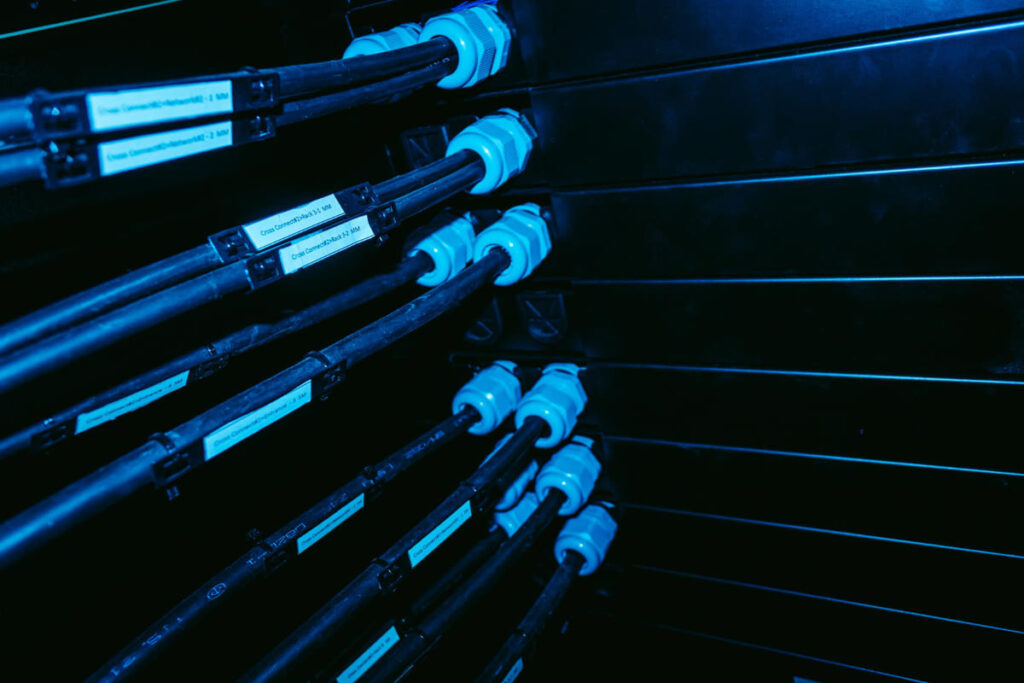
Hidden water intrusion – whether from a leaking pipe behind a wall, a small crack in a buried water main, or seepage through a dam – can cause significant damage long before it becomes visible. Fiber-optic monitoring offers a cutting-edge way to detect these hidden leaks early. By using optical fibers as sensitive sensors, it becomes possible to continuously watch over long stretches of infrastructure for any sign of water ingress. For example, a municipal water utility recently installed fiber-optic leak detection on a major pipeline and within weeks pinpointed several subtle leaks that traditional methods had missed.
Armed with real-time data from fiber sensors, the maintenance team repaired those leaks promptly, saving thousands of liters of water and preventing further erosion of the surrounding soil. This kind of insight was previously impossible; without fiber-optic monitoring, the leaks might have gone unnoticed until a major burst or structural issue occurred. In this article, we will explore six key fiber-optic monitoring techniques that make such early detection of hidden water intrusion possible, explaining how each method works and providing practical examples of their use.
Table of Contents
6 Fiber-Optic Monitoring Techniques to Detect Hidden Water Intrusion
1. Distributed Temperature Sensing (DTS)
Distributed Temperature Sensing (DTS) is a fiber-optic monitoring technique that measures temperature continuously along the length of an optical fiber. In DTS, a specialized instrument sends pulses of light down a fiber and analyzes the tiny amount of light that is scattered back. Changes in temperature at any point along the fiber cause subtle shifts in the backscattered light signal. By timing the return of the scattered light, the system can determine the precise location (often within one meter or less) of each temperature reading. The result is essentially a long thermal sensor stretching over kilometers of fiber.
How DTS Detects Water Intrusion: A hidden water leak often creates a temperature anomaly in its surroundings. For example, consider a hot water pipeline running under a city street. If a crack in the pipe allows hot water to leak into the ground, the soil at that spot will warm up relative to its surroundings. Conversely, a leak in a cold water or gas pipeline might cool the adjacent ground (for instance, pressurized gas leaks cause cooling as the gas expands).
A fiber-optic cable laid alongside the pipeline and connected to a DTS unit will register that temperature change immediately at the leak’s location. Operators monitoring the temperature profile in real time would see a sudden spike (for a hot fluid leak) or drop (for a cold fluid leak) and get an alert for a possible leak at that specific position.
Real-World Example: Distributed temperature sensing has been successfully used in pipeline networks and embankment dams to detect leaks. In one case, an oil pipeline carrying heated crude oil was equipped with a fiber-optic DTS cable. When a small leak occurred, the escaping oil warmed the soil by a few degrees at the leak site. The DTS system identified this hot spot within minutes, allowing maintenance crews to respond before the leak grew.
Similarly, in earthen dam monitoring, fibers are embedded in the dam structure to detect seepage: if water starts seeping through, it often cools or dampens sections of the dam’s interior. The DTS system will show an abnormal temperature pattern, guiding engineers to investigate that area for potential water intrusion.
Key Advantages of DTS:
-
Continuous Coverage: A single fiber can monitor temperature over tens of kilometers, providing a complete temperature profile along critical infrastructure.
-
Early Anomaly Detection: Even a slight change (on the order of a few tenths of a degree) can be detected, so small leaks can trigger alerts before they worsen.
-
Localization: DTS can pinpoint the location of a temperature anomaly (and thus a potential leak) typically within one-meter accuracy, enabling targeted inspections and repairs.
-
Passive and Durable Sensor: The fiber itself has no powered electronic sensors in the field – it is immune to electromagnetic interference and can operate in harsh environments (underground, underwater, or in chemically aggressive soils) without risk of sparks or corrosion.
Suggested article to read:
2. Distributed Acoustic Sensing (DAS)
Distributed Acoustic Sensing (DAS) transforms a standard fiber-optic cable into an array of virtual microphones that detect vibrations and sound along its length. DAS works by sending laser pulses down the fiber and measuring the backscatter similar to DTS, but with a focus on detecting dynamic strain changes in the fiber caused by vibrations. When a sound or vibration (such as the noise from water leaking under pressure) occurs near the fiber, it creates minute strain disturbances in the fiber. The DAS system can sense these disturbances at high frequencies and determine their location.
How DAS Detects Water Intrusion: A pressurized water leak often produces a distinct acoustic signature – imagine the hissing sound of water spraying out of a small hole, or the gurgling of water escaping into soil cavities. DAS can pick up these subtle noises. For instance, if a fiber-optic cable is laid along a pipeline or woven into a building’s structure, the system can continuously “listen” for the sound of water leaks.
When a leak starts, the fiber near that point will detect the vibration from the rushing water. The DAS interrogator interprets this as an acoustic event and flags the location. Advanced signal processing software is usually employed to distinguish leak noises from other ambient vibrations (such as traffic or machinery), ensuring the system is reliable with minimal false alarms.

Real-World Example: A regional water company in Europe recently trialed a fiber-optic acoustic monitoring system on a 40 km section of aging water mains. By connecting an interrogator to unused telecom fibers running parallel to the pipes, they turned those fibers into leak detection sensors without having to lay new cables. During the trial, the system successfully detected multiple simulated leak events. In one instance, a small valve leak was opened deliberately: the fiber picked up the faint hissing sound and pinpointed the leak within about 0.5 m of accuracy.
The trial also showed that the system could detect indirect signs of leaks, such as changes in soil vibration patterns when the ground became saturated with water – in this case, the fiber could even sense a leak several meters away because water pooling in the soil altered how vibrations traveled through the ground. Thanks to DAS, leaks that normally might run for months unnoticed were identified in real time. This continuous acoustic monitoring allowed maintenance teams to fix issues quickly, preventing sinkholes and reducing water loss.
Key Advantages of DAS:
-
Long Range, Real-Time Listening: A single DAS interrogator can monitor tens of kilometers of fiber, continuously capturing acoustic activity along infrastructure in real time.
-
High Sensitivity: DAS can detect very small vibrations – from the high-frequency hiss of a pinhole leak in a pipe to the low-frequency thud of a pipe crack or even footsteps. This sensitivity helps catch tiny leaks early.
-
Non-Intrusive Installation: The fiber sensor can often be attached to the outside of a pipe or buried nearby. In some cases, existing fiber-optic cables (such as telecommunication fibers running near water pipes) can be repurposed for DAS, avoiding the need for disruptive excavation.
-
Event Discrimination: Modern DAS systems use machine learning algorithms to differentiate leak noises from other events. This means they can filter out background noise (like road traffic or construction) and focus on the acoustic signatures of water escaping, improving reliability.
-
Applications Beyond Leaks: In addition to leak detection, the same DAS setup can alert operators to other issues such as pipe tampering or unauthorized digging (by detecting vibrations from tools) and even monitor for ground movements (landslides or subsidence) that might threaten the pipeline.
3. Distributed Strain Sensing (DSS)
Distributed Strain Sensing (DSS) uses fiber optics to measure strain or deformation along the entire length of an optical fiber. Typically based on Brillouin scattering technology, DSS systems send signals through the fiber and detect changes in the reflected light frequency, which correlate with strain (stretching or compression) and temperature of the fiber at each point. While DSS inherently measures both strain and temperature, careful system design or calibration (and sometimes using two fibers or special fiber types) allows engineers to distinguish mechanical strain from thermal effects. In the context of leak detection, DSS focuses on identifying physical changes – bending, stretching, or compression of the fiber – caused by environmental changes due to water intrusion.
How DSS Detects Water Intrusion: When hidden water leaks into a structure or soil, it can cause subtle movements or stress changes that fiber optics can sense. For example, consider a buried water pipeline made of plastic (HDPE) running through soil. If the pipe develops a leak, water saturating the ground might cause the soil to swell or the pipe to start bending slightly due to loss of support or changes in internal pressure. A fiber-optic cable bonded along the pipeline or buried nearby will experience corresponding strain changes.
The DSS system will show a deviation in the strain profile at that location, effectively highlighting the area of concern. In another scenario, think of water seeping into an earthen levee or dam: as the soil gets wet, its weight distribution and cohesion change, often leading to small shifts or settlements in the structure. Fiber-optic strain sensors embedded in the dam can pick up these minute structural deformations, providing an early warning of potential seepage long before a complete failure or visible wet spot on the downstream face of the dam.
Real-World Example: Researchers have demonstrated fiber-optic strain monitoring on plastic water pipelines to indirectly detect leaks. In one experimental setup, a fiber was helically wrapped around an HDPE water pipe. When the pipe was pressurized, the fiber recorded the normal expansion strain (the pipe swells slightly under pressure). When a controlled leak was introduced (a small hole in the pipe wall), the local pressure drop and water outflow caused a slight contraction of the pipe’s circumference near the leak and changes in the surrounding soil stress. The fiber sensed this change in hoop strain (circumferential strain) at the leak location.
Although the strain shift was extremely small, the distributed sensor clearly picked up the anomaly, demonstrating that the hoop strain monitoring approach can find leaks. This method provided continuous coverage of the entire pipe length – something that would be impractical with traditional point strain gauges placed every few meters. In civil structures, similar technology has been applied: a long fiber sensor running through a concrete retaining wall was able to detect bending strain changes caused by water ingress and soil pressure increases behind the wall, alerting engineers to waterproofing failures before major cracks formed.
Key Advantages of DSS:
-
Detection of Structural Effects: Not all leaks produce immediate noise or large temperature swings, especially slow seepages. However, they often cause physical effects (like soil heave, subsidence, or pipe deformation). DSS excels at catching these mechanical indicators of leaks.
-
Full-Length Coverage: Like other distributed techniques, DSS monitors every meter of fiber, which could translate to an entire pipeline or a broad area of a dam, providing a complete strain map rather than isolated data points.
-
Combination with Temperature Sensing: Many distributed systems today are dual-purpose, measuring both strain and temperature. This means one fiber installation can serve both as a DTS and DSS. Combined data can help differentiate a real leak (which might cause both strain and temperature changes) from environmental effects (like uniform temperature changes due to weather).
-
Useful for Integrity Monitoring: Beyond leak detection, distributed strain sensing is invaluable for general structural health monitoring. It can detect ground movement (landslides, settling) along pipelines or track the development of strain in a wall or tank, helping prevent failures. This dual utility can justify the installation of fiber sensors as they provide a wide range of safety data.
4. Fiber Bragg Grating (FBG) Sensor Networks
Fiber Bragg Gratings (FBGs) are a type of point sensor that can be multiplexed along an optical fiber. An FBG is a tiny, periodic variation inscribed in the fiber’s core that reflects a specific wavelength of light. When conditions around an FBG change – such as temperature, strain, or even the presence of certain chemicals – the reflected wavelength shifts. By monitoring these wavelength shifts, one can precisely measure the local environmental changes at each grating’s location. Dozens or even hundreds of FBG sensors can be written along a single fiber, each tuned to reflect a different wavelength, allowing a network of point sensors to be read with a single instrument.
How FBGs Detect Water Intrusion: FBG sensors can be designed to measure temperature, strain, pressure, or humidity, all of which are relevant for detecting water leaks. For instance, an FBG glued to a pipe’s surface will experience strain if the pipe expands or bends (perhaps due to a leak’s pressure effect) and will also track temperature at that spot (which might drop if water evaporates or if cold water leaks).
By analyzing the data, a sudden temperature change or an unusual strain reading at one sensor location could indicate a leak or water ingress right there. Additionally, FBGs can be specially packaged or coated to measure moisture directly. For example, an FBG can be coated with a hygroscopic (water-absorbing) material: when the material gets wet, it swells and strains the FBG, causing a measurable wavelength shift. This effectively turns the FBG into a humidity or liquid-water sensor that triggers when it encounters moisture.
Real-World Example: A practical deployment of FBG sensors for leak detection was in a wastewater tunnel monitoring system. In that system, engineers placed FBG-based humidity sensors at critical junctions where pipes connected, areas prone to seepage. They also installed strings of FBGs along the tunnel wall to measure any unusual strain or temperature changes. During testing, when a small leak occurred at a joint, the FBG at that location recorded a sharp increase in relative humidity, and adjacent FBGs detected a slight drop in temperature as the leaking water evaporated and cooled the area.
This combination of signals provided a clear indication of a leak, and its location was pinpointed to the exact joint. In building maintenance, FBG sensors have been embedded in walls and ceilings of sensitive facilities (like archives and data centers) to detect water ingress. If a roof starts leaking or a pipe in the wall seeps, an FBG sensor in those structures will pick up the moisture or the cooling effect and immediately alarm, long before the water accumulates enough to be noticed visibly.
Key Advantages of FBG Sensor Networks:
-
High Precision at Key Points: FBGs are extremely accurate and can measure tiny changes in strain or temperature. This makes them excellent for early detection of subtle leak effects at specific high-risk points (for example, pipe joints, welds, or wall penetrations where leaks are likely to start).
-
Multiple Sensors on One Fiber: Many FBGs can share one fiber line, and each sensor’s reading is independent. This reduces cabling needs and allows a large area or multiple pieces of equipment to be monitored with one system. For example, a single optical fiber can have FBGs placed every few meters along a pipeline or around a tank, creating a network of smart sensors.
-
Customizable and Versatile: FBG sensors can be tailored to different needs by changing their packaging. They can measure temperature alone, strain alone, or be made responsive to moisture by adding special coatings. This versatility means an FBG network can provide a multifaceted view (structural, thermal, and moisture) of the infrastructure’s health.
-
Fast Response and Recovery: FBGs respond almost instantly to changes and can be read at high frequencies (hundreds of hertz or more), meaning they will catch rapid events (like a sudden pipe burst or pressure surge). They also tend to have good stability and repeatability over time, ensuring reliable long-term monitoring for leak onset.
-
Compact and Non-Intrusive: Each FBG sensor is tiny – essentially just a small segment of the fiber – adding no bulk. They can be embedded in materials (concrete, composite, soil) or attached flush to surfaces without affecting the integrity of the structure, which is ideal for retrofitting in existing buildings or pipelines.

5. Swellable Polymeric Fiber Sensors
Swellable polymeric fiber sensors are a specialized type of optical fiber leak detector that rely on materials which physically swell or change when exposed to water. In these sensors, the optical fiber is combined with or coated by a water-sensitive polymer (often a hydrogel or a super-absorbent polymer). When the polymer comes into contact with water or even just high humidity, it expands. This expansion can cause micro-bending of the optical fiber, or it can induce strain in the fiber or in an embedded grating. In either case, the presence of water leads to a significant change in the fiber’s light transmission or reflection characteristics, which can be monitored.
How Swellable Polymer Sensors Detect Water Intrusion: Imagine a long cable that you lay around the perimeter of a room, underneath an elevated floor, or along the length of a pipe. This cable looks like an ordinary fiber-optic cable but has an outer layer of a material that reacts to water. Under normal dry conditions, light travels through the fiber with minimal losses. However, if water so much as touches a part of this cable, the special polymer jacket at that spot will soak up the moisture and swell.
That swelling action may press on the fiber or bend it slightly. Instantly, the light signal in the fiber will attenuate or a reflective marker in the fiber will shift at that location. By using an instrument like an Optical Time Domain Reflectometer (OTDR) or an FBG interrogator, the system notices the sudden change and determines where along the cable it happened (using the travel time of the reflection or loss). Essentially, the cable itself acts as a continuous water sensor, triggering an alarm as soon as a portion gets wet.
Real-World Example: An example of this technology in action is in data center facilities and building leak detection systems. Data centers often have leak detection cables laid under raised floors where cooling pipes run. One modern solution uses fiber-optic cables with swellable polymers for this purpose. In one reported incident, a hairline crack in a cooling pipe began to drip water onto the floor. The drip was small, not enough to puddle or set off traditional flood sensors immediately. But within minutes, the creeping moisture contacted the fiber-optic leak detection cable. The polymer around the fiber swelled at that spot, causing a sharp change in the fiber’s signal.
The monitoring unit flagged a leak at a precise location – down to a few meters accuracy in a room filled with equipment racks. Staff quickly found and fixed the dripping pipe, preventing what could have developed into a major outage. Similarly, in municipal sewers, researchers have tested polymer-coated fiber sensors along sewer mains. During trials, even a slight weeping of sewage through a pipe joint (which is hard to detect by other means) was picked up by the fiber cable, as the moistening of the surrounding area caused the polymer to swell and trigger the sensor. This proved that even very small leaks in grimy, wet environments could be distinguished when using a properly designed swellable fiber sensor system.
Key Advantages of Swellable Polymer Fiber Sensors:
-
Direct Detection of Water: These sensors respond to the physical presence of liquid water (or high moisture) directly, rather than inferring it from temperature or sound. This makes them highly reliable for confirming that water is actually where it shouldn’t be.
-
Distributed Sensing Ability: A single long cable can cover a wide area or length. Unlike point moisture detectors, the fiber cable can snake along every critical location (perimeters of rooms, along pipes, around equipment) to ensure no leak goes unnoticed. Essentially, the entire cable is a sensor.
-
Fast and Automatic Response: The swelling reaction and optical change happen within seconds of exposure to water. There is no need for power at the leak site – the detection and signaling are all optical. This gives an immediate alert without requiring any electrical wet contacts or complex electronics in the field.
-
Minimal False Alarms: The polymer can be engineered to react only to water (or specific fluids), making it mostly indifferent to dust or other contaminants. And because the trigger is a physical swelling, random environmental noise or temperature changes are unlikely to cause false signals. As long as the cable remains dry, the system stays quiet.
-
Robust and Low Maintenance: These leak sensing cables have no moving parts or electrical circuits, which makes them robust. They can endure rough handling, and after a water incident is detected and addressed, many polymer fiber cables can be dried out and reused (though some may need a section replaced if the polymer doesn’t fully return to shape). Maintenance usually just involves periodic testing and ensuring the cable hasn’t been damaged or moved out of place.
6. Evanescent Field Fiber Sensors
Evanescent field fiber sensors utilize the principle of light’s evanescent field – the small portion of a light wave that extends just outside the fiber’s core into the cladding or surrounding medium – to detect changes in the fiber’s environment. In a standard fiber, light is mostly confined within the core by total internal reflection, but a tiny fraction extends into the cladding. If the fiber’s cladding or outer layer is modified or removed in a section, the evanescent field can interact with the environment directly. When the surrounding refractive index changes (for instance, when air around the fiber is replaced by water), more light can escape or be absorbed, dramatically altering the intensity of light transmitted through the fiber.
How Evanescent Field Sensors Detect Water Intrusion: Consider a simple scenario: a fiber optic cable where at certain intervals the protective jacket and a bit of the cladding are thinned or a long fiber sensor is made of a porous or side-polished fiber. Under normal conditions (dry environment), the refractive index contrast between the fiber core and the surrounding air ensures most light stays in the core, and the transmission is high.
Now, if water leaks and surrounds that exposed section of fiber, the refractive index around the fiber suddenly increases (water has a higher refractive index than air). This disrupts the conditions for total internal reflection, causing a significant portion of the light to leak out of the core into the water. The result is a notable drop in optical intensity reaching the fiber’s end or a spike in loss observed with an OTDR. By monitoring the light level or loss, the system can tell that a particular sensor segment has come into contact with water and signal an alarm.
Real-World Example: Evanescent field leak sensors have been explored in applications like fuel tank leak detection and pipeline insulation monitoring. One implementation involved an optical fiber run along a pipeline within a porous insulation layer. The fiber had periodic sensing nodes – short sections where the cladding was designed to allow external interaction. Under dry, normal conditions, the fiber passed light with minimal attenuation. However, if water or moisture infiltrated the insulation (which could happen if a rainwater jacket was compromised or a slow leak from the pipe wetted the insulation), when the moisture reached one of these fiber nodes, the light level dropped at that segment.
In tests, engineers could locate the wet segment to within a meter by analyzing the OTDR trace, thereby identifying exactly where the insulation was compromised or a leak was occurring. Another example is groundwater monitoring around buried hazardous material tanks: fibers laid in the ground around the tanks were constructed to lose light when submerged. If a tank leaked and groundwater carried contaminants, the rising moisture would hit the fiber sensors and immediately be detected by the change in light transmission. This concept provided a simple, fail-safe way to constantly watch for leaks without needing power or active devices in the soil.

Key Advantages of Evanescent Field Sensors:
-
Simplicity of Operation: These sensors often work on a straightforward binary principle – dry means high light transmission, wet means light loss. This is easy to interpret and integrate into alarm systems.
-
No Special Chemicals Required: Unlike swellable polymers, evanescent sensors don’t rely on a chemical reaction or absorption; they use fundamental optics. This means they can be very stable over time as long as the fiber surface is kept intact. They won’t “wear out” from repeated dry/wet cycling in the same way a chemical indicator might.
-
High Sensitivity to Liquids: Even a thin film of water on the fiber can cause a measurable change. They can be tuned to respond not just to water but to other liquids by adjusting the fiber design (for example, detecting hydrocarbons if needed). For water intrusion, the sensor can be extremely sensitive – catching the first drips of a leak.
-
Distributed or Quasi-Distributed Placement: Multiple evanescent sensor sections can be made along one fiber, each acting as a checkpoint for water presence. This is somewhat similar to having multiple FBGs, but here each zone is a “leak detection node” that doesn’t need a specific wavelength – just a position along the fiber. By analyzing the optical time-of-flight, each wet segment can be located.
-
Safe for Hazardous Areas: Since detection is done via light and the fiber is non-electrical, these sensors are intrinsically safe in explosive or flammable environments (e.g., monitoring leaks of water into an electrical vault or into a sensitive chemical storage area) – there’s no risk of sparks.
FAQs
How does fiber-optic monitoring detect hidden water leaks?
Fiber-optic monitoring uses sensitive optical fibers placed along pipes or structures to detect changes caused by water leaks. Depending on the method, the fiber can sense temperature changes, vibrations, strain, or direct contact with moisture. For example, a leaking pipe will cause a local temperature difference or create vibrations; the fiber detects these signals and pinpoints the leak’s location. All of this happens in real time, allowing even hidden leaks to be discovered long before they become visible.
What types of fiber-optic sensors are used for water intrusion detection?
Several types of fiber-optic sensors are deployed to catch water intrusion. The main categories include distributed sensors like DTS (for temperature changes along the fiber), DAS (for acoustic/vibration sensing), and DSS (for strain/deformation sensing). There are also point sensors such as Fiber Bragg Gratings (FBGs) that measure conditions at specific spots (like temperature, strain, or humidity at a sensor location). Additionally, specialized fiber cables with moisture-sensitive coatings (swellable polymers or exposed core sections) are used to directly detect contact with water. Each type plays a role in identifying leaks under different conditions.
Which industries or facilities benefit most from fiber-optic leak detection?
Fiber-optic leak detection is valuable in any context where undetected water leaks can cause problems, but it’s especially beneficial for water utilities, oil and gas pipelines, industrial plants, and critical buildings. Municipal water networks use fiber optics to reduce non-revenue water losses by catching pipeline leaks early. Oil and chemical industries deploy these sensors to detect leaks in pipelines or tanks to prevent environmental damage. Civil engineering projects like dams, levees, and tunnels use fiber monitoring to spot seepage or cracks. Even commercial buildings and data centers employ fiber-optic cables under floors or in walls to detect plumbing leaks or roof leaks, protecting equipment and infrastructure from water damage.
Is fiber-optic leak detection reliable and cost-effective?
Yes, modern fiber-optic leak detection has proven to be both reliable and increasingly cost-effective. The sensors are highly sensitive and provide continuous monitoring, which means they often catch leaks that other methods miss. Reliability is high because optical fibers are immune to electromagnetic interference and can withstand harsh environments for years with little maintenance.
In terms of cost, the initial installation can be an investment, but it often pays off by preventing major leak damages, reducing water loss, and lowering manual inspection expenses. Moreover, technologies like using existing telecom fibers for sensing or multiplexing many sensors on one fiber have made solutions more affordable. As fiber-optic monitoring becomes more common, economies of scale are also driving costs down, making it a practical choice for many applications.
Conclusion
Fiber-optic monitoring is revolutionizing the way we detect hidden water intrusion in pipelines, buildings, and critical infrastructure. By leveraging the unique properties of light in optical fibers, these techniques provide continuous, real-time surveillance over vast lengths and areas that were previously impractical to monitor. We have explored six distinct fiber-optic techniques – from distributed temperature and acoustic sensing to point-specific FBG networks and innovative moisture-sensitive cables – each offering a window into different aspects of leak detection. In practice, these methods are often combined to provide a comprehensive early warning system: temperature sensors catch thermal hints of leaks, acoustic sensors listen for telltale hisses, strain sensors feel the subtle shifts in structures, and specialized fiber sensors directly sniff out moisture.
The result is a proactive approach to water intrusion management. Issues that once took weeks or months to discover can now be identified and located in a matter of minutes or seconds. This not only prevents costly damage and water loss but also improves safety by mitigating risks before they escalate. Fiber-optic monitoring techniques, with their objectivity and precision, are becoming indispensable tools in maintenance and infrastructure management, ensuring that whether the threat is a pinhole leak or seeping groundwater, no drop of water goes unnoticed.
Resources:
-
MDPI. Yussof, N.A.M. & Ho, H.W. (2022). Review of Water Leak Detection Methods in Smart Building Applications.
-
MDPI. Bertulessi, M., Bignami, D.F., Boschini, I., Longoni, M., Menduni, G., & Morosi, J. (2023). Experimental Investigations of Distributed Fiber Optic Sensors for Water Pipeline Monitoring. Aquatech Online. (2024). Leak detection: back to the future with fibre optics?
-
NORSAR. (2023). Detecting Water Leaks with Fiber Technology.
-
DNV. (n.d.). Leak detection using Distributed Fibre-Optic Sensing (DFOS).
For all the pictures: Freepik
Suggested article for reading:
4 Emerging Technologies for Curing Control in Concrete Structures
Top 8 Benefits of Smart Concrete Monitoring for Quality and Sustainability
3 Case Studies Where Smart Sensor Monitoring Accelerated Concrete Projects
5 Use Cases of IoT‑Enabled Concrete Monitoring in Commercial Construction
How Concrete Monitoring Is Building Smarter Cities: 8 Real-World Examples