Maintaining clean indoor air is critical for patient care and safety in hospitals. By 2025, Air Quality Monitoring for Hospital facilities has become a standard part of building management. Continuous IAQ sensors collect data on pollutants (particles, gases, microbes) and environmental conditions (temperature, humidity, pressure) throughout wards, operating rooms and ICUs.
This data gives facilities teams a complete picture of the air environment. For example, a large medical center installed networked IAQ sensors in patient wings and discovered that some areas were over-ventilated at night. Adjusting the HVAC schedules saved roughly 20–30% on energy use while ensuring fresh air during occupied hours. Monitoring thus connects patient health with facility efficiency.
Table of Contents
Why Monitor Air Quality in Hospitals?
Hospitals serve vulnerable patients, so air quality directly affects outcomes. Poor IAQ – such as high particulate levels or stale air – can worsen respiratory conditions, delay healing, and increase infection spread. Continuous monitoring lets staff act immediately if air quality degrades. For instance, real-time CO₂ readings can reveal inadequate ventilation during busy shifts, prompting more fresh-air exchange before patient symptoms appear. A hospital that added IAQ sensors to its HVAC system found unusual chemical spikes after deep cleaning. Alerts triggered immediate filter changes and vent flushes, keeping patients and workers safe.
Benefits of Continuous Monitoring
Air Quality Monitoring for Hospital facilities delivers multiple benefits:
-
Improved Patient Safety: Monitors catch airborne contamination early (dust, VOCs, pathogens), reducing risks to patients.
-
Infection Control: Consistent IAQ data ensures negative pressure in isolation rooms and proper air changes, lowering hospital-acquired infection rates.
-
Regulatory Compliance: Data logs verify that ventilation meets standards (ASHRAE, CDC), simplifying audits and accreditation.
-
Energy Efficiency: Insight into air flows and occupancy lets teams optimize HVAC schedules. For example, automated vent controls cut idle ventilation costs by up to 20% in some hospitals.
-
Occupant Comfort: Monitoring temperature, humidity and CO₂ helps maintain comfortable conditions for patients and staff, enhancing recovery and productivity.
In one study, monitors recorded peak pollutant levels in a children’s ward during cleanup hours, enabling staff to adjust schedules and reduce exposure. Over months of continuous monitoring, that hospital cut airborne irritants in patient areas by roughly half, all while keeping ventilation rates within energy targets. This illustrates how Air Quality Monitoring for Hospital settings bridges health and operational goals.
Suggested article to read: 9 Steps to a LEED v4.1 Construction IAQ Plan That Passes the First Time
Common Pollutants in Hospital Air
Hospital air can contain a wide range of contaminants. The most common include:
Common Hospital Air Pollutants
-
Particulate Matter (PM): Tiny dust, fibers, or aerosolized blood/medical residue. PM2.5 from construction or cleaning can infiltrate wards if filters are low-grade.
-
Volatile Organic Compounds (VOCs): Chemicals from disinfectants, sterilizers, paint and building materials. Formaldehyde and other VOCs off-gas from furnishings and lab plastics.
-
Carbon Dioxide (CO₂): Elevated CO₂ indicates poor ventilation and high occupancy. Monitoring CO₂ helps adjust fresh-air intake, especially in crowded waiting rooms or lecture halls.
-
Microbial Bioaerosols: Bacteria, viruses, and fungal spores. These can spread via recirculated air if filters or UV systems fail. Continuous sampling (or carbon-dioxide proxy) helps manage infection risk.
-
Gases and Fumes: Anesthetic gases (e.g. nitrous oxide), solvent vapors, and chemical fumes. Proper duct exhaust monitoring prevents buildup in ORs and labs.
-
Humidity and Temperature: High humidity can promote mold; low humidity dries mucous membranes. Monitoring and controlling these keeps patients comfortable and inhibits pathogen growth.
Unique Hospital Challenges
Hospitals have special IAQ challenges. For instance, operating rooms require very high air change rates and strict filtration; sensors ensure those targets are met continuously. Isolation rooms need stable negative pressure; pressure sensors tied into alarms warn if doors or fans are out of spec. Labs and pharmacies may emit formaldehyde or alcohol fumes, so zone-specific monitors trigger extra ventilation during drug preparation. Even staff activities (like spray disinfectant in a patient room) can spike VOCs; mobile or temporary sensors can detect these events so restrooms or rooms can be aired out.
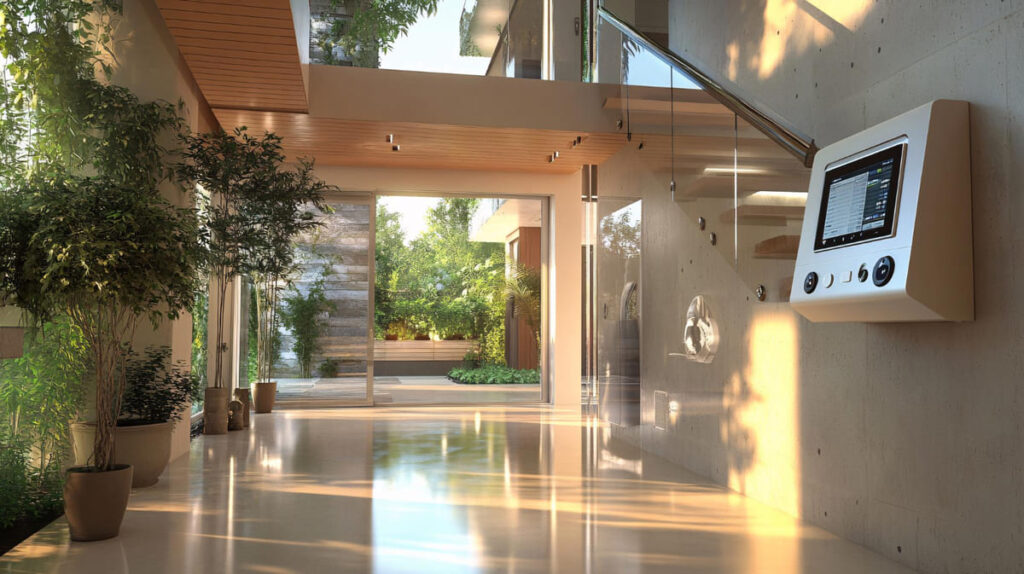
Monitoring systems are designed for these contexts: rugged to run 24/7, accurate to medical standards, and networked for central control. For example, wall-mounted IAQ stations track several gas and particle levels, and link to the Building Management System (BMS) through secure protocols. This ties Air Quality Monitoring for Hospital environments directly into energy systems and alert dashboards.
Monitoring Technologies and Sensors
Modern IAQ monitoring uses a variety of sensor technologies. These devices are often part of an IoT network with cloud analytics. Key sensor types include:
IAQ Sensors and Devices
-
Laser Particle Counters: Measure PM1.0, PM2.5 and PM10 continuously. These give real-time data on dust or smoke in hallways, enabling automatic filter checks.
-
NDIR Gas Sensors: Detect CO₂ or CO. Hospitals use them to gauge ventilation efficiency and to spot faulty boilers or generators.
-
Electrochemical and Metal-oxide Gas Sensors: Monitor VOCs (often reported as total VOC index) and specific gases like NO₂ or formaldehyde. These sensors run in OR corridors and labs to flag solvent fumes or sterilant leaks.
-
Pressure Sensors: Differential pressure sensors on room doors ensure isolation rooms stay at correct pressure. Linked alarms notify staff if pressure reverses.
-
Humidity/Temperature Sensors: Track comfort and mold risk. Hospital HVAC frequently maintains 40–60% relative humidity; deviations trigger alerts.
-
Microbial and Particle Samplers: Advanced systems periodically capture airborne microbes for lab analysis, though these are usually part of infection-control audits rather than continuous monitors.
Modern IAQ systems tie these sensors into analytics platforms. A hospital’s network might include wall-mounted monitors in nursing stations and mobile units on wheels for isolated checks. Data streams from devices are aggregated in dashboards. Machine-learning algorithms detect trends: for example, a recurring VOC spike every afternoon led one hospital to adjust its cleaning schedule to after-hours with extra venting.

Integration with Building Systems
Sensors alone are not enough – they must integrate with building controls. Continuous data (often at 5–15 minute intervals) feed into the BMS. The BMS can automatically adjust dampers, fans or dampeners. For instance, if CO₂ stays low, fresh-air intake can be dialed back to save energy; if PM spikes outside a cleanroom, high-speed exhaust fans kick in. Alerts can also be sent by email or text to facilities staff.
Such integration turned around a case where a poorly maintained air handler was repeatedly overheating ICU patients. After linking IAQ monitors to the automation system, technicians rewrote the fan schedule, cutting wasteful night-time cycling. In just two months, energy consumption tied to ventilation dropped by nearly half, and temperature swings in patient rooms disappeared. This shows how Air Quality Monitoring for Hospital environments not only protects health but also improves energy efficiency.
Implementation and Best Practices
Deploying an effective hospital IAQ monitoring program involves clear planning and maintenance:
-
Define Objectives: Start by setting IAQ goals – for example, maintain CO₂ below 800 ppm in patient rooms, humidity between 40–60%, and PM2.5 under a target. Consider facility type (acute care, clinic, lab) and patient vulnerability.
-
Consult Standards: Align with ASHRAE (Standard 170 for healthcare ventilation, 62.1 for general IAQ) and CDC guidelines. These set target values and ventilation rates for different room types.
-
Select Quality Sensors: Choose medical-grade, building-grade monitors. They should be calibrated and (for example) comply with UL2905 or RESET Air Grade standards. Multiple parameters in one unit (CO₂, PM, VOC, etc.) simplify deployment.
-
Strategic Placement: Install monitors in representative zones – ICUs, ORs, waiting rooms, pharmacy, kitchen, and near any pollution sources (loading docks, labs). Also monitor exterior air intake to compare indoor vs outdoor levels.
-
Data Infrastructure: Ensure a reliable network (wired or secure wireless). Use a centralized dashboard to visualize trends. Enable alerts (e.g. when PM or VOCs exceed set limits). Keep historical data for trend analysis.
-
Training and Response: Train maintenance and clinical staff on interpreting IAQ data. Define response protocols – e.g., when a pollutant threshold is crossed, what ventilation or purification steps to take.
-
Calibration and Maintenance: Regularly calibrate sensors and service HVAC filters. A sensor stuck at one reading can be worse than none. Periodic audits (e.g. cross-check readings with handheld devices) keep confidence high.
By following these practices, hospitals make monitoring a proactive part of environmental health. As one hospital technician noted, “With continuous IAQ data in hand, we are no longer guessing when filters fail or when to ventilate – the system tells us.” This proactive stance is key to fully realizing the advantages of Air Quality Monitoring for Hospital facilities.

Standards and Guidelines
Hospital IAQ monitoring is guided by several standards and regulations. Key examples include:
-
ASHRAE Standards: Standard 170-2021 specifies ventilation rates for healthcare spaces (e.g. 20 air changes/hour in OR). Standard 62.1-2019 provides general IAQ requirements for occupied spaces.
-
CDC Guidelines: The CDC’s Guidelines for Environmental Infection Control (2003, updated 2019) outline air-handling practices to prevent spread of airborne pathogens in healthcare facilities.
-
EPA’s Initiatives: The EPA’s Clean Air in Buildings Challenge promotes IAQ monitoring and management. Hospitals use these guidelines to benchmark ventilation and pollutant levels.
-
Hospital Accreditation: Many accreditation bodies (e.g. The Joint Commission) require documented HVAC maintenance and acceptable air quality as part of infection control standards. Monitoring provides the documentation needed.
-
Green Building Certifications: Programs like WELL or LEED now award points for continuous IAQ tracking. For instance, LEED v5 (beta) introduces credits for hourly monitoring of CO₂, PM₂.₅ and VOCs.
By adhering to these standards, hospitals ensure that IAQ practices meet or exceed recognized safety levels. Continuous monitoring helps prove compliance: a logged record of CO₂ and particulate readings can demonstrate that patient areas always had adequate ventilation, for example. This traceability also helps identify any gap between design intent and actual performance.
FAQs
How does Air Quality Monitoring for Hospital help patient and staff safety?
Air quality monitors continuously check for contaminants (particles, VOCs, bacteria) and conditions (ventilation, humidity). This real-time data alerts staff to any harmful spikes or ventilation failures. By catching issues early, hospitals can quickly fix filtration or boost fresh air, reducing infection risk and protecting vulnerable patients and healthcare workers.
What technology is used in hospital air quality monitoring systems?
Modern hospital systems use IoT sensors and meters. Common components include laser particle counters, gas sensors (for CO₂, VOCs, etc.), humidity/temperature sensors, and pressure sensors for isolation rooms. These devices are networked into building management software. Mobile units or fixed monitors report data every few minutes, feeding dashboards and automatic control systems.
Which standards govern indoor air quality in healthcare facilities?
Several standards apply, including ASHRAE Standard 170 (ventilation requirements for health care) and ASHRAE 62.1 (general IAQ). The CDC’s infection control guidelines also specify air change rates and filtration. Accreditation programs and green building certifications increasingly require IAQ documentation. Hospitals use these standards as targets, and monitoring helps verify they are met.
Is it true that continuous air quality monitoring saves energy and reduces infection risks?
Yes. By tracking indoor air in real time, hospitals can optimize HVAC use – for example, reducing ventilation when rooms are unoccupied – which cuts energy use (often 20% or more). At the same time, monitors ensure air exchange rates never fall below safe levels, so infection control is not compromised. In practice, facilities that adopted continuous IAQ monitoring have reported both lower energy bills and improved patient outcomes.
Conclusion
By 2025, Air Quality Monitoring for Hospital has proven to be an indispensable tool for healthcare facility management. Continuous monitoring with smart sensors and data analytics links patient safety, staff well-being, and operational efficiency. Hospitals use IAQ data to catch air quality problems before they impact patient care, to verify that ventilation systems are performing correctly, and even to save energy by fine-tuning HVAC operation. Real-world examples show dramatic results: halved pollutant levels, 20–30% energy savings, and robust records for regulators.
In an era of digital medicine and smart buildings, hospital air is no exception to the data revolution. Clear procedures, quality sensors, and responsive automation turn raw data into action – whether that means opening a damper, fixing a filter, or alerting maintenance. The focus on Air Quality Monitoring for Hospital environments reflects a broader commitment: ensuring that the very air patients breathe supports their healing, rather than hindering it.
Resources:
-
Camfil. (2024). Determining Specific Indoor Air Quality Goals in Hospitals and Healthcare Facilities.
-
American Society of Heating, Refrigerating and Air-Conditioning Engineers (ASHRAE). (2021). ANSI/ASHRAE/ASHE Standard 170-2021: Ventilation of Health Care Facilities.
-
Centers for Disease Control and Prevention (CDC). (2003). Guidelines for Environmental Infection Control in Health-Care Facilities.
-
United States Environmental Protection Agency (EPA). (2021). Clean Air in Buildings Challenge.
For all the pictures: Freepik
Suggested article for reading:
Top 6 Sustainable Material Handling Practices Driving Green Construction
8 Biggest Material Handling Challenges in Construction and How to Overcome Them
12 Jobsite Material-Handling KPIs to Track Before They Blow Your Schedule
7 Material Handling Breakthroughs in Construction for 2025 (Electric Telehandlers, Smart Cranes, AMRs)
6 Exoskeleton Wins That Reduce Material-Handling Injuries on Site