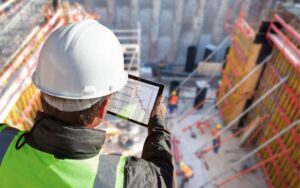

Construction sites are dynamic and hazardous environments, with heavy machinery, extreme weather, loud noise, and changing layouts creating constant safety challenges. Traditional safety measures can struggle to keep up, especially on temporary projects. In response, leading IoT companies have developed wearable safety solutions that provide real-time monitoring and proactive protection on construction sites. These high-tech wearables, embedded with sensors and connectivity, allow construction managers to track worker well-being, prevent accidents, and respond swiftly to incidents. This article highlights four top IoT innovators and their wearable technologies that are making construction sites safer.
Table of Contents
Top 4 Leading IoT Companies Delivering Wearable Safety Solutions
1. Triax Technologies – Real-Time Worksite Visibility and Alerts
Triax Technologies is a pioneer in connected construction wearables, known for its Spot-r system – a network of wearable sensors that provide comprehensive, real-time visibility into jobsite safety. The Spot-r clip is a small IoT device worn by workers on their belts or hardhats that forms its own wireless mesh network across the site. This means managers get instant insight into each worker’s location and movement without relying on GPS or external internet.
If a worker slips or falls, the IoT device’s accelerometer automatically detects it and sends an alert pinpointing the location to supervisors. Crew members can also signal emergencies by pressing a button on the wearable, notifying site managers immediately of incidents like injuries or hazards. These instant alerts allow a rapid response – often cutting reaction time from minutes to seconds. The system also supports site-wide evacuation alarms: managers can trigger an alarm on all devices (through lights or buzzers) so that everyone evacuates quickly and knows it’s not a drill.
Beyond responding to active incidents, Triax’s platform captures valuable workforce data that helps prevent accidents. Gilbane Building Company implemented Spot-r on a complex multi-building renovation. They reported that automated headcounts and zone tracking saved time and ensured no workers were left in hazardous areas unnoticed. Spot-r’s dashboard integrated with their existing project management software to simplify compliance tasks (like verifying work hours for payroll and safety records). Over the project, the real-time data also helped identify congestion hotspots on site; managers used these insights to reconfigure workflows and improve both safety and efficiency. Triax’s success in delivering a safer, connected jobsite has made it one of the leading IoT companies in construction safety.
Key features of Triax Spot-r include:
-
Automatic Fall Detection: Instantly alerts supervisors when a worker may have fallen, enabling rapid medical response.
-
Panic Button Alerts: Workers can call for help or report an issue with one button press, sending their ID and location to the safety team.
-
Evacuation and Geofence Alarms: Managers can issue site-wide evacuation notices via the wearable; unauthorized or dangerous area entries can trigger alerts.
-
Data Analytics & Integration: All sensor data feeds into a cloud dashboard for analytics. It can integrate with existing project management tools to streamline compliance (e.g., work-hour logs and safety reports).

2. Guardhat (Aatmunn) – Smart Hard Hats for Connected Safety
Guardhat (recently rebranded as Aatmunn) has reimagined the standard hardhat as an advanced IoT safety device. The Guardhat “Communicator” is a smart hard hat equipped with a suite of sensors, communications gear, and a robust software platform behind it. At a glance, the helmet looks familiar, but it contains embedded technology: high-definition cameras, microphones, a GPS module, motion detectors, and environmental sensors for factors like temperature or gas. All of these are connected through wireless networks (Bluetooth, Wi-Fi, or LTE), effectively turning the helmet into a mobile safety hub on the worker’s head.
This wearable solution continuously monitors the worker’s surroundings and status. For example, the Guardhat can detect if the wearer is getting too close to a hazardous piece of equipment or entering a restricted zone, and it will issue warnings in real time. It tracks the worker’s precise location on-site, and if an incident occurs – such as an impact to the helmet or the worker collapsing – the system immediately notifies a central safety control center.
Through the built-in audio/video capabilities, an injured or endangered worker can communicate hands-free with remote supervisors or emergency responders. The helmet’s panic button allows a user to call for help with one touch, initiating a live link with safety personnel who can see and hear what’s happening via the helmet’s camera and microphones.
Guardhat’s IoT platform aggregates data from these smart hard hats (and other wearables) into a comprehensive dashboard. Safety managers can watch a real-time map of all personnel, set up virtual “geofences” for danger zones, and receive alerts for anomalies like sudden accelerations (which might indicate a fall or collision) or exposure to harmful conditions. The system also integrates with other enterprise safety systems to enable data analysis that helps predict and prevent accidents. For example, analyzing near-miss and exposure data over time can reveal patterns that inform better safety protocols or targeted worker training.
Key capabilities of Guardhat include:
-
Real-Time Hazard Alerts: Detects proximity to dangers (moving equipment, drop zones, hazardous gases) and warns the worker and control center instantly.
-
Two-Way Communication: Enables voice calls and video streaming directly from the helmet, so experts off-site can guide the worker or assess a situation remotely.
-
Location and Impact Sensing: Provides live positioning of each worker. Registers impacts or unusual motions (as from a fall or being struck) and triggers immediate alerts.
Suggested article to read: Top 101 Construction Company in World; 2024 Review

3. WakeCap – Helmet Sensors Enabling Site-Wide Visibility
WakeCap is a global IoT company that focuses on connecting workers through simple, effective wearable devices attached to their existing hardhats. The WakeCap solution consists of a lightweight sensor unit that snaps onto a standard helmet, instantly turning it into a “smart” hardhat. These helmet sensors form a mesh network across the jobsite, automatically logging each worker’s location and activity and relaying that data to a cloud platform in real time.
On a major high-rise project, for example, one contractor outfitted 400 workers with WakeCap devices to achieve total site visibility. This eliminated the need for manual headcounts and allowed managers to know exactly how many workers were in each area at any moment. During safety drills or real emergencies, they could verify within seconds that everyone was evacuated, instead of spending critical minutes searching. The system’s two-way alerts also improved incident response: if an injury occurred, nearby workers and supervisors were notified immediately along with the victim’s exact location, enabling faster first aid.
WakeCap can even extend beyond personnel tracking. The same IoT network can tag equipment and monitor environmental conditions on site. By digitizing not just people but also tools and climate data, it helps identify potential safety issues (like overheated areas or unauthorized equipment use) and drives more proactive site management.
Highlights of WakeCap’s solution:
-
Seamless Hardhat Integration: A snap-on sensor that fits any standard helmet, making adoption easy with no special wearables required.
-
Mesh Network Tracking: Wireless self-networking devices provide complete coverage of a site without Wi-Fi or GPS, delivering real-time location data for all workers.
-
Two-Way Safety Alerts: Instant evacuation notifications to all workers; field workers can report hazards or call for help directly through the helmet device.
4. Kenzen – Wearable Health Monitors for Worker Safety
Kenzen is a leading IoT company focusing on the health aspect of construction safety, using wearable biometric sensors to prevent heat-related illnesses. Its solution is a small smart patch worn on a worker’s upper arm that continuously measures vital signs (like heart rate and skin temperature) along with the ambient temperature. From these readings, Kenzen’s system can estimate the wearer’s core body temperature in real time – a key indicator of heat stress.
When a worker’s core temperature gets too high, the system sends automatic alerts so that action can be taken before the person collapses from heat exhaustion. The worker’s device vibrates and notifies them to take a break and hydrate. At the same time, supervisors see an alert on their dashboard and can immediately direct that worker to rest. Work can resume once the system shows the person’s temperature has dropped back into a safe range.
This proactive approach has already averted incidents on pilot job sites. Supervisors found that workers often ignore early heat stress symptoms, but with Kenzen’s objective alerts they were able to pull individuals out of danger at the right time. Some contractors even adjusted schedules based on Kenzen data – for example, performing heavy tasks during cooler morning hours and adding more water breaks – leading to a noticeable drop in heat-related illnesses. Over time, the aggregated data helps safety managers spot patterns (such as certain times of day or specific crews with frequent heat alerts) and refine their heat mitigation plans for the future.

Key aspects of Kenzen’s smart PPE system:
-
Continuous Core Temp Monitoring: Tracks workers’ vital signs and predicts core body temperature continuously to catch heat stress before it becomes dangerous.
-
Real-Time Alerts & Guidance: Sends alerts to workers and supervisors with actionable recommendations (rest, hydrate, cool down) when thresholds are crossed.
-
Data-Driven Prevention: Aggregated data identifies patterns (e.g., time-of-day or location-based heat risk), allowing management to adjust schedules, install cooling stations, or enhance training.
FAQs
How do wearable IoT devices improve safety on construction sites?
Wearable IoT devices improve construction site safety by providing real-time monitoring and instant alerts. They can detect falls, hazardous proximity to machinery, dangerous environmental conditions (like high heat or toxic gas), and more. When a risk or incident is detected, the device immediately notifies both the worker and supervisors so they can respond quickly. These devices also collect data over time to help identify unsafe patterns or areas on the site, enabling managers to make informed changes to prevent accidents.
What are examples of wearable safety technology used by leading IoT companies?
Examples include clip-on sensors like Triax’s Spot-r that detect falls and track worker locations, and Guardhat’s smart hardhat which has built-in cameras and sensors to monitor surroundings with two-way communication. Other devices are WakeCap’s helmet sensor for real-time site-wide tracking and Kenzen’s armband that monitors vital signs to prevent heat stress.
Which construction companies are using IoT wearables for safety?
Many contractors around the world are using IoT wearables. For example, firms like Skanska, Gilbane and CCC have used Spot-r clips and WakeCap sensors on projects. They report faster emergency responses, easier safety compliance, and fewer incidents. Adoption of these technologies is spreading globally as more construction managers see the benefits.
Is it true that wearable IoT technology can reduce construction site accidents?
Yes. Wearable technology has shown strong potential to reduce construction site accidents. By alerting workers and supervisors to danger in real time, these devices can prevent some incidents – for example, warning someone before they enter a hazard zone or prompting a break if a worker is overheating. Early adopters have reported fewer accidents and better emergency drill results after introducing wearables. While no device can eliminate all risk, combining this technology with good training clearly improves safety.
Conclusion
Innovative wearable IoT technologies are quickly becoming essential tools for construction safety management. The four companies profiled – Triax, Guardhat, WakeCap, and Kenzen – show how leading IoT companies are delivering practical solutions to longstanding safety challenges on job sites. By combining real-time data collection with intelligent analytics, these wearables give construction managers unprecedented visibility into site conditions and worker health.
The result is safer working conditions: faster emergency responses, fewer unnoticed hazards, and more prevention of accidents and health issues. Around the globe, forward-thinking contractors are deploying these IoT wearables to protect their teams and improve productivity. While technology alone cannot eliminate all risks, early successes demonstrate that a connected jobsite is a safer jobsite. As these solutions become as common as hardhats and vests, the construction industry is entering a new era of safety driven by IoT innovation.
Resources:
-
Engineering News-Record. (2021). Skanska Sees Benefits of Worker Tracking Tech on California Hospital Project.
-
Construction Dive. (2020). Improve safety and security with Spot-r on occupied job sites.
-
Construction Management (CIOB). (2018). Wearable tech digitises construction workforce.
-
CONEXPO-CON/AGG. (2022). Improving Jobsite Productivity and Safety with Smart Helmets.
-
EHS Daily Advisor. (2020). Kenzen Launches Body Heat Sensor System for Predictive, Preventive Worker Safety.
For all the pictures: Freepik
Suggested article for reading:
Top 6 Robotic and LiDAR Sensor Integrations Powering Autonomous Construction Equipment
8 IoT Sensor Use Cases Revolutionizing Modern Construction Sites
9 Digital Twin Sensor Applications Driving Real-Time Project Insights
6 Examples of Robotic Bricklaying and On‑Site Assembly in Construction
10 Government Policies for Solar Panels into New Builds in 2025
5 Ways AI is Revolutionizing Asset Tracking and Management
6 Must-know AI Tools for Construction Managers
5 Real‑World Applications of BIPV: From Facades to Canopies
10 Ways of Integrating Digital Twin Technology with Fabrication Workflows