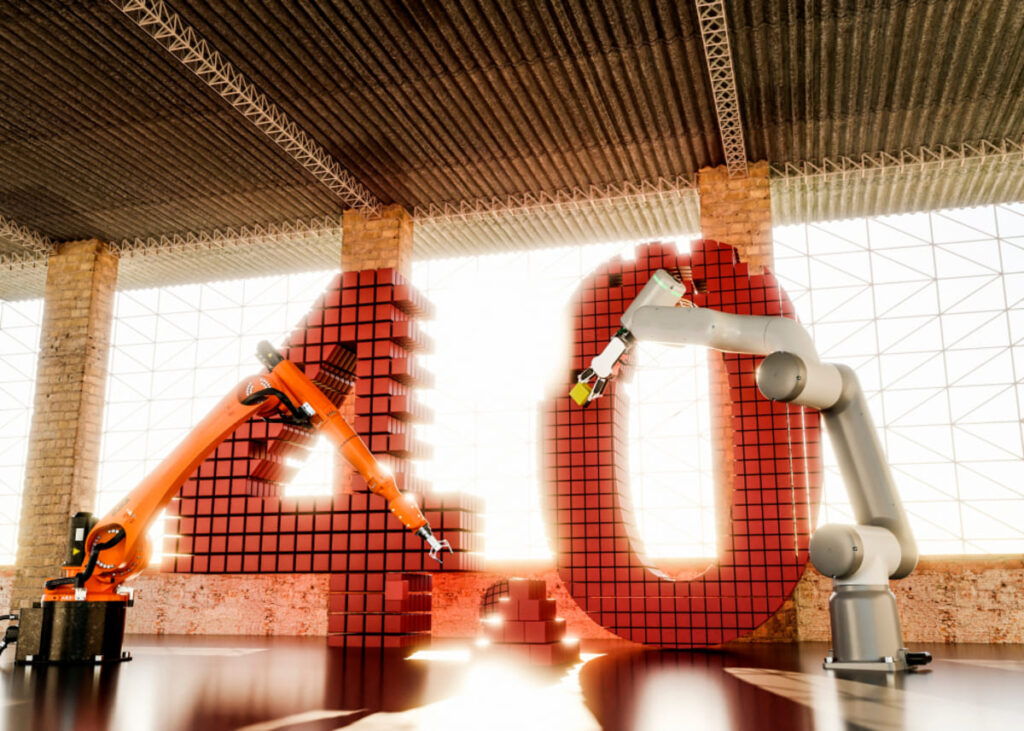
Robotic automation is making inroads into the construction sector, taking over repetitive and labor-intensive tasks. Robotic bricklaying and on-site assembly technologies aim to boost productivity, improve safety, and address skilled labor shortages. The following six real-world examples illustrate how robots are being used to build walls, lay bricks, and assemble construction components directly on site in a variety of projects around the world. Each example provides a practical look at the robot in action, explaining how it works and what benefits it brought to its project.
Table of Contents
1. SAM100 – Semi‑Automated Mason Assisting Bricklayers on Site (USA)
The SAM100 (Semi-Automated Mason) is a bricklaying robot designed to work alongside human masons on construction sites. Developed by Construction Robotics in New York, SAM100 was one of the first commercially available robotic bricklaying systems. It uses a robotic arm with a conveyor and pump to apply mortar and place bricks in position with laser-guided precision. Crucially, SAM is not fully autonomous – it acts as an assistant that does the heavy lifting and repetitive laying, while skilled crew members handle setup and finishing tasks like aligning bricks at corners and tooling the mortar joints.
Real-world example: In 2018, SAM100 was deployed in the construction of the University Arts Building in Reno, Nevada. The robot laid over 60,000 bricks for the building’s exterior walls, roughly two-thirds of the total bricks used. On that project, SAM operated at a pace of about one brick every 8 seconds – over 400 bricks per hour under ideal conditions. In practice, it consistently placed around 200–250 bricks per hour, far outpacing human bricklayers who might lay about 250 bricks in an entire day. This productivity boost enabled the masonry subcontractor to complete the brickwork months faster than usual.
While SAM handled the repetitive lifting and placing of each brick, a team of five masons worked alongside it to load bricks and mortar into the machine, monitor its operation, and take care of details like corners, window openings, and cleanup. Even with a crew assigned to support it, SAM substantially reduced the manual workload on those masons. The project manager noted that the robot effectively did the work of five bricklayers, allowing the contractor to redeploy human workers to other critical tasks.
How it works: The SAM100 system is set up on site, typically on a moving scaffold or platform that travels along the length of a wall. A digital layout of the wall (based on the building plans) guides the robot’s arm. The machine automatically spreads mortar onto each brick, then precisely places the brick onto the growing wall according to the programmed pattern.
A laser guidance system and sensors ensure each course is level and aligned. SAM can even create standard brick patterns or company logos by varying the placement as programmed. However, the robot is best suited for long, straight runs of wall – human masons still handle irregular areas like corners, edges, and any bricks around obstacles because SAM requires a relatively uniform workspace to operate efficiently.
Benefits observed: In the Nevada project and others, using SAM led to about a 50% faster installation of brick veneer compared to all-manual work. It relieved workers from the most backbreaking part of the job (repeatedly lifting and placing bricks and mortar), thereby reducing fatigue and the risk of injuries. Importantly, contractors see SAM as a way to mitigate skilled labor shortages in masonry – rather than replacing masons, it augments a smaller crew to accomplish the same work volume.
On the University Arts Building, one mason noted that while a team of five worked with SAM, he could deploy other available crews to different parts of the project simultaneously, effectively speeding up the overall schedule. This example shows how a semi-automated bricklaying robot can seamlessly integrate into a jobsite, improving efficiency while allowing experienced tradespeople to focus on the more detailed or skilled aspects of construction.
Suggested article to read: Bricklaying Robots in Construction Automation; 2024 Guide
2. Hadrian X – Fully Autonomous Bricklaying Robot Building Homes (Australia)
Hadrian X is a fully autonomous robotic bricklayer developed by the Australian company FBR (Fastbrick Robotics). Unlike SAM, which assists human workers, Hadrian X is designed to automate the entire bricklaying process from start to finish with minimal human intervention. The system is mounted on a large truck base and features a 32-meter robotic boom arm.
This arm can pick up concrete masonry blocks, apply a bonding agent, and precisely place each block according to a digital building plan. The technology includes an advanced control software and a Dynamic Stabilization System that actively corrects for environmental factors like wind or vibrations, allowing the long boom to set blocks with millimeter accuracy even in less-than-ideal field conditions.
Real-world example: In November 2018, Hadrian X successfully completed its first full-scale test build – it constructed the shell of a three-bedroom, 180-square-meter house in under three days under controlled conditions. This proof-of-concept demonstrated the robot’s ability to work continuously and accurately, laying courses of blocks to form all the exterior walls of a house. Each block Hadrian X places is much larger than a standard brick (approximately 12 times the size) and weighs up to 45 kg, reducing the total number of units needed.
The robot uses a special high-strength construction adhesive instead of mortar, which sets quickly and ensures strong bonding between blocks. In its test build, Hadrian X achieved a placement rate of around one block every 45–60 seconds. Because each block is equivalent to a dozen traditional bricks, this is comparable to installing over 1,000 standard bricks per hour in effective output. The manufacturer claims the robot can erect the walls of a typical house in about one to two days of work, a task that could take a crew of masons several weeks by hand.
After refining the technology through such trials, FBR moved Hadrian X into pilot programs in actual developments. For instance, in 2020 the robot built its first house on a construction site in a suburb of Perth, and since then it has constructed several full-scale homes in Australia. The robot has drawn international interest as well: a major Mexican homebuilder partnered with FBR to pilot the system for affordable housing, and discussions have been held in Saudi Arabia about deploying Hadrian X for large-scale housing projects.
In 2023, one of Hadrian’s units was shipped to the United States for evaluation, and it was showcased building portions of a house in Florida – marking the robot’s first use in North America. These projects highlight Hadrian X’s potential to standardize and speed up residential construction on a global scale.
How it works: Hadrian X operates by converting a digital 3D model of a building into precise instructions for each block’s placement. The “brain” of the system is software that takes CAD plans and breaks them down into data for every block – size, type, and exact coordinates in the wall. On site, the truck-mounted robot is first calibrated and positioned. Bricks or blocks are loaded into an automated feeder on the truck.
The robotic arm picks up each block, cuts it if needed for corners or fitting, applies a thin layer of construction adhesive, and then extends to position the block at the correct spot in the growing wall. Throughout this process, the Dynamic Stabilization Technology actively compensates for any sway or movement in the long boom arm, ensuring each block is placed exactly where intended even if the arm is moving or external forces act on it.
This allows unprecedented accuracy over large distances – for example, the system can account for a gust of wind in real time and still set a block correctly. Because Hadrian X uses an adhesive rather than traditional mortar, there is no need to pause for mortar to cure; the blocks bond quickly and the robot can keep working without long interruptions. The result is a continuous, automated bricklaying process driven entirely by the digital building model.
Benefits observed: Hadrian X demonstrates several key advantages of full automation. First, it offers speed and efficiency at a level beyond human capability – by working around the clock with high-speed placement, it dramatically reduces the time to build masonry structures. This could significantly lower labor costs and help meet tight project schedules or housing demands. Second, it achieves high precision and minimal waste; the robot’s software knows exactly how many blocks are needed and places each with consistent quality, virtually eliminating human errors or uneven workmanship.
This lean approach can reduce material waste (especially since excess mortar is not an issue with adhesives) and ensure that follow-on work (like roofing or window installation) fits perfectly to the plumb walls. Safety is another benefit: Hadrian X keeps human workers off scaffolds and away from repetitive heavy lifting. Instead of a crew handling thousands of bricks, operators simply monitor the robot’s progress and supply materials as needed.
Finally, by industrializing the masonry process, the technology addresses the chronic labor shortage in bricklaying trades – it can take on large-scale projects in markets where skilled bricklayers are scarce. While fully autonomous systems like Hadrian X are still new, these early projects show how they can revolutionize on-site assembly, particularly for standard housing designs, by delivering speed and consistency previously unattainable in manual construction.
3. ABLR – Robotic Bricklaying for a House Construction in the UK
The Automatic Brick Laying Robot (ABLR) is a system developed by a UK-based firm, Construction Automation, to build houses using traditional bricks and mortar through automation. This robot represents a different approach from Hadrian X – instead of using specially designed blocks or adhesives, ABLR is engineered to work with standard bricks, blocks, and mortar commonly used on construction sites. The goal is to seamlessly integrate with existing building practices (and building codes) while automating the most labor-intensive parts of the process.
Real-world example: In late 2020, ABLR was put to the test by constructing what was reported as Britain’s first robot-built home, a three-bedroom house in Everingham, Yorkshire. The robot operates on a track and tower system: essentially, a 9-meter-tall vertical frame that moves along rails set around the building’s footprint. As the tower travels along the walls, a robotic laying arm applies mortar and sets bricks layer by layer.
Uniquely, ABLR can handle corners and building an entire enclosed structure without stopping – it was designed to “build around corners,” meaning it doesn’t require resetting for each wall. In the Yorkshire project, the machine was intended to complete the brick shell of the house in about two weeks with only two on-site workers supporting it. One worker keeps the robot fed with bricks and mortar from ground level, while another works from a lift alongside the robot to perform tasks like placing wall ties, installing insulation or damp-proof courses, and ensuring any details are finished properly.
During this trial, the ABLR demonstrated the ability to lay bricks accurately according to the digital plan of the house. It reads CAD drawings of the house design and follows those coordinates precisely. The system proved capable of placing bricks at a steady pace and maintaining level courses as it rose up the structure. The robot’s creators highlight that it can build using the same materials and methods as human builders – standard bricks and mortar – which simplifies integration into current construction processes.
Notably, to address variations in brick sizes (since no two bricks are exactly identical), the ABLR uses an innovative technique: it positions each brick at a calculated spacing and then pumps mortar into the joints, automatically adjusting the mortar thickness to fill any small gaps. This ensures that despite minor size differences in bricks, the finished courses remain level and structurally sound without needing manual adjustment. Laser sensors on the robot continuously check alignment and level as well.
The initial deployment did encounter some “teething problems” typical for a prototype on site. For example, dust from other equipment occasionally interfered with the robot’s laser sensors, and there were minor issues with the track sinking slightly on soft ground, requiring readjustment. Such challenges slowed the project’s timeline during the trial phase.
However, the concept was proven successful – the robot managed to build significant portions of the house, validating that a largely autonomous system can handle a full-scale residential building with complex geometry (including corners and openings). After this project, the company aimed to refine the technology and launch it commercially, touting that future setups could be delivered to site in shipping containers and assembled to build houses with minimal local adjustments.
How it works: The ABLR consists of a mobile robotic arm attached to a tall scaffold-like tower that moves on rails. Before construction begins, the rails are laid out around the building’s foundation to allow the robot to slide along each exterior wall. Once in place, the robot is calibrated with the digital blueprint of the house. It uses a combination of machine vision and reference markers to know its exact location on the site.
As it commences work, a brick hopper and mortar pump supply the materials to the robotic arm. Guided by the digital plan, the arm picks up a brick, applies mortar either on the brick or directly on the wall (depending on the layer and pattern), and sets the brick down to form the wall. It proceeds course by course, climbing up the tower as the wall grows in height. The robot’s software can signal when manual intervention is needed – for instance, when it’s time for the human assistant to place a structural element like a steel lintel over a window, or to insert ties that secure the brick veneer to backing structure.
After the human completes that step, the robot continues laying bricks above that element. This coordinated dance between robot and human ensures that all building components are properly installed. ABLR also uses sensors and cameras to verify each brick’s placement; it takes photographs or scans of each completed section to create an as-built digital record. If any brick is slightly off, the system can detect it and alert the operators.
Benefits observed: The ABLR example highlights several benefits of robotic on-site assembly. For one, it drastically reduces the manual labor required to build a masonry house. Instead of a large crew of bricklayers working for months, the core bricklaying can be handled by a robot with just a couple of operators. This can alleviate the issue of finding enough skilled bricklayers, an acute problem in the UK construction industry. From a speed standpoint, the developers claim the robot-built house could be completed in roughly half the time of conventional methods once initial kinks are ironed out – in the trial, they projected two weeks for the shell, whereas traditional methods might take several weeks with a full crew.
Another benefit is consistency and quality control: the robot’s precise placement and automated mortar application yield very uniform brickwork, potentially improving the finish and strength of the walls. By working from a digital model, the system also simplifies planning and logistics; exact material quantities are known and waste is minimized (excess mortar usage, for example, can be reduced by pumping just the needed amount). Furthermore, using familiar materials (bricks, blocks, mortar) means that existing supply chains and design practices don’t need to change – the robot enhances productivity without forcing a shift to entirely new building systems.
Finally, there’s a safety and ergonomic benefit: fewer workers have to perform repetitive heavy lifting or climb scaffolds for extended periods. Instead, those workers supervise the robot or handle finer tasks, which can be less physically taxing. In summary, the ABLR project demonstrated that robotic bricklaying can be integrated with traditional construction, achieving faster build times and labor savings while maintaining conventional building standards.
4. Tiger Stone – Automated Brick Road Paving Machine (Netherlands)
Not all robotic bricklaying happens vertically on walls – the Tiger Stone is an example of automated brick assembly for horizontal surfaces like roads and walkways. Developed in the Netherlands by Vanku BV, Tiger Stone (also dubbed a “road printer”) is a mobile machine that lays out brick pavements with minimal manual labor. While it’s not a robot in the sense of having an articulating arm, it automates the placement of paving bricks in a bed of sand, creating an instant road surface as it moves.
Real-world example: The Tiger Stone has been used in multiple Dutch towns to quickly pave small roads, driveways, and public plazas with brick or cobblestone patterns. A typical demonstration involves the machine laying a new brick road several meters wide in one continuous pass. For instance, municipal public works departments have employed Tiger Stone to rebuild neighborhood streets far more efficiently than traditional methods. In use, the machine is positioned at one end of the section to be paved.
Workers load bricks onto its hopper and arrange them by hand in the desired pattern (such as herringbone or stretcher bond) on a sloping slide at the front of the machine. Once arranged, gravity causes the patterned row of bricks to slide down the incline. The Tiger Stone then slowly drives forward (on caterpillar tracks) and feeds that row of bricks directly onto the prepared sand bed on the ground. As it advances, it continuously lays out new rows behind it, essentially “printing” the road from loose bricks.
With 2–3 laborers feeding bricks and positioning them on the machine, Tiger Stone can lay an impressive amount of roadway in a short time. It’s been reported to pave at least 300 square meters of road per day with a small crew. This is roughly equivalent to a 5-meter-wide stretch of road that’s 60 meters long, completed in one day. By comparison, a traditional road paving crew manually placing bricks on sand might only cover on the order of 75–100 square meters in a day.
Thus, Tiger Stone can be three to four times faster than manual paving and requires fewer workers hunched over on their knees. One example project saw a residential street paved in just a couple of days, whereas it might have taken a week or more manually. The finished quality is consistent, since the bricks are placed tightly together in one go, and the machine’s onboard sensors help it steer straight along a guide (such as a curb or string line) to keep rows aligned.
How it works: Tiger Stone is essentially a gravity-powered brick laying system guided by a mobile frame. The machine comes in different widths (ranging around 4 to 6 meters) to accommodate various road sizes. To begin, a level sand substrate is prepared as the road base. Operators then load bricks into the Tiger Stone’s top hopper.
Standing on the platform, they manually arrange the bricks edge-to-edge on a wide metal chute in the pattern required. The key is that workers do not have to bend over to place bricks on the ground; they simply shuffle bricks into place on the machine from a comfortable height. Once a section of the pattern is set on the chute, the machine’s drive is engaged.
As Tiger Stone creeps forward, the edge of the chute slides over the sand base, and the arranged bricks slide off and land in position on the sand. Because the bricks interlock as they slide down, they form a contiguous paved surface. The machine continuously feeds out the brick layer like a carpet, and the workers keep adding new bricks to the top. Built-in sensors or mechanical guides keep the machine on course, following the curb or predetermined path, to ensure a straight and uniform placement. After laying, a compactor or tamper can be run over the newly placed bricks to set them firmly into the sand bed.
Benefits observed: The Tiger Stone illustrates how automation can improve ergonomics and efficiency for a very labor-intensive task. By eliminating the need for pavers to bend, kneel, and individually place each brick on the ground, it significantly reduces the physical strain and injury risk for workers. Instead of many workers laboring on their hands and knees, just a few can handle a much larger output using this machine.
Productivity is greatly increased – roads can be opened to traffic sooner because the paving stage is completed faster. The machine also helps achieve a uniform finish; bricks are placed with tight, consistent joints, which can improve the longevity and appearance of the pavement. For contractors or municipalities, Tiger Stone can lower labor costs and timelines for paving projects.
The system also reduces waste and rework: since bricks are placed correctly on the first pass and guided by the machine, there are fewer misalignments or gaps to fix later. Additionally, the electric operation of Tiger Stone keeps noise and pollution low compared to some heavy machinery, making it suitable for use in residential areas. Overall, Tiger Stone is a compelling example of on-site assembly automation where repetitive manual tasks are streamlined, resulting in both human benefits (less drudgery) and project benefits (faster completion and consistent quality).
5. TyBot – Autonomous Rebar Tying Robot for Bridge Construction (USA)
On construction sites, assembling reinforcing steel (rebar) for concrete structures is a crucial but labor-intensive process. TyBot, developed by Advanced Construction Robotics (ACR) in the U.S., addresses this by automating the tedious task of tying rebar intersections. This robot doesn’t deal with bricks at all; instead, it is an example of on-site robotic assembly in concrete construction. By mechanizing rebar tying, TyBot improves safety and productivity for projects like bridges, decks, and other large concrete slabs.
Real-world example: TyBot has been successfully used on dozens of bridge projects across the United States. One notable example took place in 2023 on a bridge deck along Interstate 39 in Wisconsin. In this project, after workers had laid out the grid of steel rebar for the bridge’s concrete deck, TyBot was deployed to fasten the rebar intersections with wire ties. The robot, which travels along a gantry frame over the rebar mat, automatically locates each crossing of steel bars and wraps a tie wire to secure them together – a job traditionally done by laborers twisting wires by hand at every junction.
Over the course of two night shifts on the Wisconsin bridge, TyBot completed approximately 17,800 ties across a 7,800-square-foot area of deck. This output equated to a steady rate of over 1,100 ties per hour. For comparison, a skilled worker might tie around 200 rebar intersections per hour for a short period, and significantly fewer as fatigue sets in over a long shift. By the project’s end, TyBot’s contribution helped the crew finish the rebar installation phase on time and within budget, despite a tight schedule.
Contractors who used TyBot reported that the robot consistently ties rebar at 4-5 times the speed of a typical crew, and it can operate continuously without breaks. In the Wisconsin case, the subcontractor noted that the robot’s help was a “major asset” in meeting the deadline. Importantly, TyBot also improved working conditions – crew members didn’t have to bend over or kneel thousands of times to tie wires, reducing physical strain.
The contractor observed that less manual tying meant workers experienced less fatigue and fewer repetitive stress injuries, potentially extending their careers by avoiding chronic back and joint issues. TyBot has been deployed in over 40 projects in at least a dozen states, tying over 3.5 million intersections to date. Another project example comes from a bridge in Pennsylvania, where similar productivity gains and safety improvements were recorded. In all cases, the robot typically works under the supervision of one technician, freeing up other ironworkers to focus on tasks like placing rebar or setting up formwork concurrently.
How it works: TyBot is an autonomous machine that runs on a temporary track or gantry system placed over the rebar assembly. Before operation, workers install a gantry crane-like frame spanning the width of the structure (e.g., across a bridge deck).
TyBot is mounted on this frame and can move along it to cover the entire area of the rebar grid. The robot is equipped with cameras and sensors that detect the geometry of the rebar below. It uses an algorithm to identify the crossover points of rebar where a tie is needed. Once it locates an intersection, a robotic arm descends, feeds a piece of wire around the crossing, twists it securely, and then moves on to the next.
The system self-navigates across the grid, systematically tying every required point without needing direct control from workers. TyBot is designed to be largely self-sufficient: it doesn’t require detailed programming or a pre-marked map of tie locations. Instead, it “sees” the rebar pattern in real time and decides where to tie, which makes it easy to set up on any new project without extensive calibration. The robot can operate during day or night and in various weather conditions, since tying rebar is not affected by light or moderate rain. This flexibility means contractors often run TyBot during overnight shifts, effectively doubling productivity when human crews might be less available.
Benefits observed: The adoption of TyBot on site yields multiple benefits. Productivity is the most obvious – by tying over a thousand intersections per hour, the robot can substantially cut down the duration of the rebar installation phase. On a big bridge deck that might require tens of thousands of ties, what used to take a crew several days could be finished in a single day or night with TyBot. This accelerates the project schedule, allowing concrete pouring and subsequent steps to happen sooner.
Labor efficiency is another benefit: tying rebar is a low-skill, exhausting task, and using TyBot means contractors can allocate their skilled ironworkers to more complex activities (like setting rebar in place or building forms) while the robot handles the drudgery. This is particularly valuable given skilled labor shortages – the robot enables a smaller crew to accomplish what a much larger crew would normally do. From a quality standpoint, TyBot provides consistent tie spacing and tight, uniform ties every time, which can enhance the structural performance (each tie is secure, reducing risk of rebar movement when concrete is poured).
But perhaps the most significant impact is on worker health and safety. Rebar tying traditionally involves repetitive bending and twisting motions, often in harsh weather or awkward postures, leading to fatigue and injuries. TyBot essentially eliminates most of that exposure: workers are no longer spending hours bent over the steel mat, which reduces the chances of heat exhaustion, back injuries, or slips and trips on the rebar. They also avoid the minor cuts and punctures that come with handling wire ties continuously.
Additionally, by automating a portion of the work, TyBot can help contractors maintain social distancing or minimal crew sizes when needed (an advantage recognized during recent pandemic-related work restrictions). In summary, TyBot’s example in bridge construction shows how robots can augment construction crews, taking on monotonous assembly tasks to improve speed and safety, and enabling skilled workers to be more productive in other areas.
6. Hilti Jaibot – Robotic Overhead Drilling for On-Site Assembly (Global)
Another facet of on-site assembly in construction is the installation of mechanical, electrical, and plumbing (MEP) systems. These often require extensive drilling of holes in concrete ceilings or floors for running pipes, conduit, and ventilation. The Hilti Jaibot is a semi-autonomous mobile robot that tackles this overhead drilling task. While not laying bricks or tying rebar, Jaibot exemplifies robotic assistance in construction assembly: it marks and drills installation points in concrete with precision, guided by digital plans. This relieves human workers from repetitive overhead drilling and ensures faster, more accurate execution of MEP layouts.
Real-world example: Hilti’s Jaibot has been deployed on construction sites in Europe and North America for high-rise commercial projects. One example is a new headquarters building for a transit authority in Maryland, USA, where contractors tested Jaibot in 2021. The robot was used to drill hundreds of anchor holes in concrete slab ceilings for hanging electrical and plumbing infrastructure.
In this trial, the Jaibot worked on multiple levels of the building, handling the layout and drilling tasks that would normally require workers to be on scissor lifts or ladders for extended periods. The results were impressive: the project team reported that Jaibot could drill all the required holes on a given floor in roughly one-quarter of the time it would take a manual crew. For instance, if a set of ceiling inserts would have taken four days to mark and drill by hand, the robot accomplished it in about one day. This time savings sped up the overall MEP installation schedule significantly.
Another example occurred in Finland, on a multi-story residential building site managed by construction firm YIT. Jaibot was brought in as a pilot – it was the first site in that country to use the robot. Over the course of the project, Jaibot was employed on three separate floors, where it autonomously drilled thousands of holes for sprinkler and electrical mounts.
The robot in fact set a local record by completing more holes per day than any manual crew had achieved on similar projects. Site managers observed that the accuracy of placement was near-perfect, as Jaibot drilled exactly where the BIM (Building Information Modeling) plans indicated, with each hole correctly marked and spaced. The robot also captured data on its work, uploading information such as number of holes drilled and their locations to a cloud system. This gave the project managers real-time progress tracking and quality assurance that all required spots were drilled.
How it works: The Hilti Jaibot is essentially a robot on wheels with a drilling arm that reaches upward. Before it begins work, the construction team prepares a BIM model of the building’s MEP systems. This digital model contains the coordinates of every hole that needs drilling in the concrete slabs for inserts, hangers, or pass-throughs.
On site, a human operator first uses a robotic total station (a laser positioning device, like Hilti’s PLT 300) to establish reference points and help the Jaibot know its exact location on the floor. The operator then uploads the BIM data for that floor’s ceiling into the Jaibot. The robot navigates itself to the precise spot for each hole using indoor positioning – it compares its sensor readings (from laser scanners or cameras) to the BIM coordinates.
Once in position, the Jaibot uses an extendable arm with a drill to mark the point (often with a dot of spray paint to indicate which trade the hole is for) and then drill the hole to the specified diameter and depth. It has an integrated dust extraction system to capture concrete dust at the source, keeping the work environment cleaner. After drilling, it updates the record to note that hole as complete, and then moves on to the next.
The robot can be controlled via remote tablet by the operator, who can intervene or guide it around obstacles as needed, but the actual drilling and positioning are automated. Importantly, the Jaibot is designed with safety scanners that create a virtual protective bubble – if a person comes too close while it’s operating, the robot will pause to avoid any accidental contact.
Benefits observed: The use of Jaibot on site brings several notable benefits. Productivity and speed are a major advantage: it can consistently drill dozens of holes per hour without slowing down or needing breaks, which means large layouts get done much faster. This helps projects stay on schedule, especially in the critical path of fitting out a building’s services. Accuracy and consistency are also improved – since Jaibot works directly from digital plans, the chances of human error (mis-measuring or mis-marking hole locations) are eliminated.
Every hole is placed exactly where it should be, which makes the subsequent installation of pipes and supports go smoother (parts fit as intended when holes align correctly). Moreover, by capturing as-built data, the robot allows for easy verification that all tasks have been completed as planned. Another significant benefit is worker safety and health.
Overhead drilling is physically demanding; workers normally have to strain upward with heavy tools, often in awkward positions, which can lead to shoulder and neck injuries over time. By offloading this task to the robot, workers avoid continuous overhead work and exposure to vibration and silica dust from drilling. Instead, one technician supervises from a comfortable position, reducing fatigue and risk. In addition, keeping workers off ladders and lifts for extended periods lowers the likelihood of falls or accidents. Jaibot essentially lets the crew focus on assembly and preparation tasks at ground level while it does the dangerous overhead part.
The technology also addresses labor shortages in skilled trades – many regions face a lack of experienced drillers or installers, and a robot can fill that gap by handling repetitive tasks and allowing the available workforce to cover more ground. Finally, the adoption of a BIM-driven robot like Jaibot encourages better planning and coordination. Since everything must be mapped out digitally beforehand, it often leads to fewer clashes and rework in the field. In conclusion, the Hilti Jaibot is a clear example of how robotic tools are expanding beyond just “bricklaying” to other on-site assembly tasks, making construction processes safer, faster, and more precise.
FAQs
How do robotic bricklaying machines work?
Answer: Robotic bricklaying machines use programmed designs and sensors to lay bricks in order, mimicking a mason’s process. They typically have a robotic arm that picks up each brick, applies mortar or adhesive, and sets the brick into position guided by lasers or cameras. The robot follows a digital blueprint of the wall, ensuring each brick is placed at the correct location and level. Human operators provide materials and oversee the process, but the actual placement and alignment of bricks are automated for speed and accuracy.
What are the benefits of robotic bricklaying on construction sites?
Answer: Robotic bricklaying offers several key benefits in construction. It significantly increases productivity – robots can lay bricks or blocks much faster than human workers, shortening project timelines. It also improves consistency and precision, resulting in high-quality workmanship with level courses and uniform mortar joints. Safety is another benefit: robots take over the heavy lifting and repetitive motions, which reduces the physical strain on human masons and lowers the risk of injuries. Additionally, using robots can help alleviate labor shortages by handling tasks that are hard to staff, all while allowing skilled tradespeople to focus on more detailed or critical work.
Which tasks in construction can robots automate besides bricklaying?
Answer: Beyond bricklaying, robots are being used to automate a variety of construction tasks. Some robots assemble structural components, such as tying steel rebar grids for concrete structures or even positioning large prefabricated elements. Others focus on finishing and installation tasks – for example, there are robots that can drill holes in concrete for MEP installations (like the Hilti Jaibot), lay floor tiles or bricks for paving (like Tiger Stone), or even paint and inspect surfaces. Robots are also used in earthmoving (autonomous bulldozers or excavators) and for site monitoring and surveying. In essence, any repetitive, labor-intensive job on site that follows a predictable pattern is a candidate for automation.
Is it true that construction robots will replace human builders?
Answer: Not exactly – construction robots are more likely to augment human builders than outright replace them in the foreseeable future. Robots excel at repetitive, strenuous tasks like laying bricks, tying rebar, or drilling hundreds of holes, performing these jobs quickly and without fatigue. However, human expertise is still needed for complex decision-making, custom craftsmanship, supervision, and handling unexpected issues on site.
In practice, robots take on the heavy or tedious work, while humans focus on planning, quality control, and skilled finishing tasks. Rather than eliminating jobs, robotic technology can make construction work safer and more efficient, with crews working alongside machines. The industry is moving toward human-robot collaboration, where automation fills labor gaps and boosts productivity but human builders remain essential for a successful project.
Conclusion
Across these six examples, it’s evident that robotic bricklaying and on-site assembly are becoming practical reality in construction. From laying bricks and blocks for walls to assembling rebar and drilling installation points, robots are taking on repetitive tasks that were once solely done by hand. These technologies bring notable benefits: faster project completion, greater precision, and improved safety for workers. They also help mitigate skilled labor shortages by allowing smaller crews to achieve more.
However, the examples also show that robots complement rather than completely replace human workers – success often comes from a collaboration between automation and skilled crews. The robots handle the heavy or monotonous work, while humans provide oversight, handle complex details, and ensure quality. As the construction industry continues to innovate, such robotic systems are poised to become standard tools on job sites, leading to a more efficient and safer building process. The six cases discussed here demonstrate the early strides in this robotic revolution and provide a glimpse of how construction might evolve with increased automation.
Resources:
-
New Atlas. Coxworth, B. (2010). The brick-road-laying Tiger Stone.
-
Construction Dive. Goodman, J. (2023). Rebar-tying robot slashes time on Wisconsin bridge project.
-
HITT Contracting Inc. (2021). Bringing Robotics to the Jobsite.
For all the pictures: Freepik
Suggested article for reading:
5 Ways AI is Revolutionizing Asset Tracking and Management
6 Lightweight Rooftop Solar Panel Innovations for Commercial Buildings
4 Advanced PV Materials – Bifacial, Perovskite & More for Building Use
3 Solar Storage & Thermal Hybrid Strategies for Net‑Zero Buildings
5 Real‑World Applications of BIPV: From Facades to Canopies
6 Must-know AI Tools for Construction Managers