
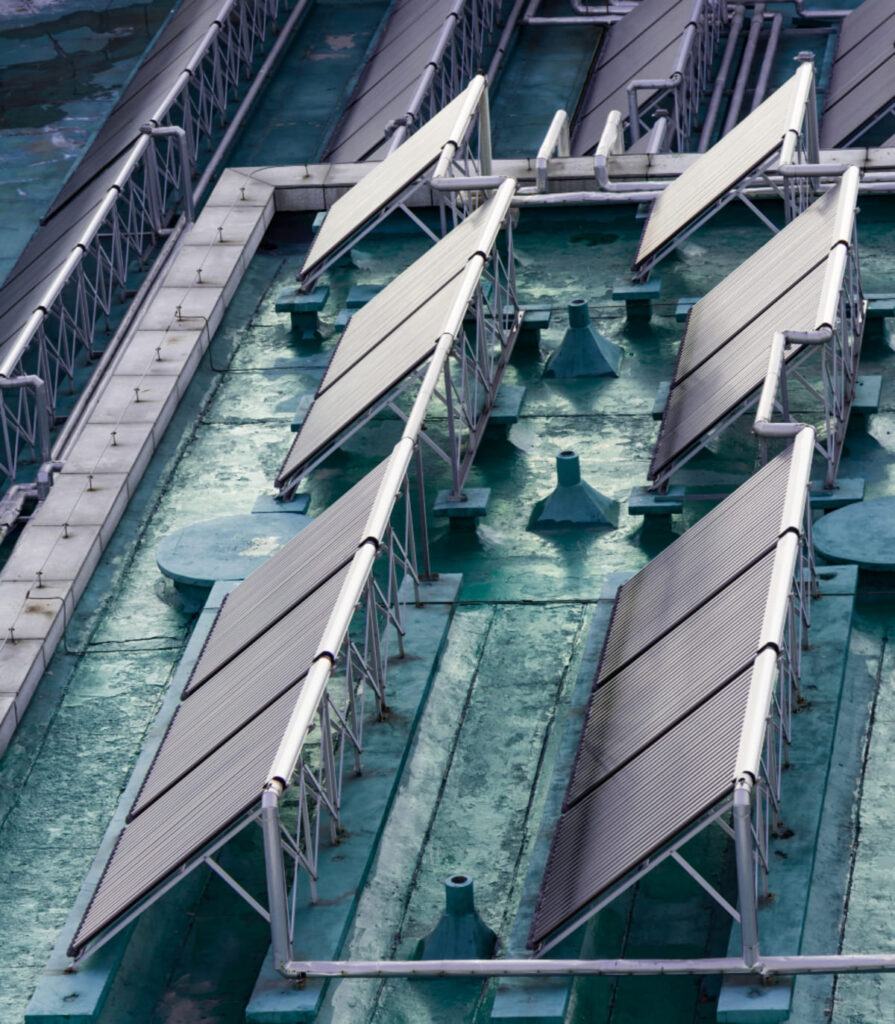
Photovoltaic (PV) technology is rapidly evolving beyond traditional silicon panels. Advanced PV materials are opening new possibilities for integrating solar power directly into buildings. These innovations offer improved efficiency, flexibility, and aesthetic integration compared to standard PV. This article examines four cutting-edge PV materials – bifacial solar panels, perovskite solar cells, thin-film photovoltaics, and organic photovoltaics – for use in buildings worldwide.
Table of Contents
Bifacial Photovoltaic Panels
Overview and Key Advantages
Bifacial solar panels generate electricity from sunlight on both their front and back sides. Unlike conventional one-sided modules, bifacial designs capture reflected and diffuse light from surfaces like rooftops or the ground. By harvesting light from both sides (even under diffuse light or low-angle sun), bifacial panels can produce 5–20% more energy than single-sided panels in many installations. In highly reflective environments (such as over snow or white roofs), gains of up to ~30% have been observed, significantly boosting output.
Applications in Buildings
Bifacial PV technology is versatile for building applications, especially where surfaces can reflect light or panels can be elevated:
-
Commercial rooftops and canopies: Installing bifacial panels above a high-reflectance roof (e.g. a white membrane) or as solar carports allows the backside to capture light reflected from the roof or pavement. Many commercial buildings and parking structures use this approach to get extra energy yield without additional roof area.
-
Vertical façades and balustrades: Bifacial panels can be integrated into building façades or balcony railings. Mounted vertically, the front side captures direct sun while the rear side catches ambient light reflected from the ground or surroundings. An east-west oriented bifacial facade, for example, can generate power from both morning and afternoon sun, improving energy output for high-rise buildings.
-
Awnings and sunshades: Buildings can use bifacial PV modules as sunshade louvers or awnings above windows. They simultaneously provide shade (reducing cooling loads) and generate power from both direct sun above and reflected light from the building. This dual-function design enhances energy generation without compromising functionality.

Perovskite Solar Cells
Overview and Key Advantages
Perovskite solar cells are an emerging PV technology named after their light-harvesting material, which has a crystal structure similar to the mineral perovskite. These cells have attracted intense interest due to rapid efficiency gains and potential for low-cost manufacturing. Key advantages of perovskite PV materials include:
-
High efficiency potential: In just over a decade, perovskite cells have reached power conversion efficiencies above 25% in labs, rivaling silicon. In tandem with silicon (stacked cell designs), they can surpass 30% efficiency, pointing to panels with far greater energy output than today’s standard solar modules.
-
Low-cost fabrication and flexibility: Perovskite films can be printed or coated at low temperatures on various substrates (including flexible plastic). This promises cheaper production and ultra-light, bendable solar panels. The material’s chemistry is tunable, allowing for semi-transparent or even colored solar cells that can function as power-generating windows or facade elements.
One challenge for perovskite PV is long-term durability – early perovskite cells degraded quickly from moisture and heat. However, recent research has greatly improved stability using protective coatings and improved cell architectures. Modern encapsulated perovskite cells have demonstrated multi-year lifespans, making them increasingly viable for real-world use.
Applications in Buildings
Perovskite solar technology is still transitioning from lab to market, but pilot projects are already showing its promise for building-integrated photovoltaics (BIPV):
-
Tandem panels on roofs: Perovskite-on-silicon tandem panels (combining a perovskite cell with a silicon cell) are expected to be used on rooftops. These hybrid panels look like standard modules but offer much higher efficiency, allowing more solar power from the same roof area.
-
Solar windows & glass: Perovskite cells can be made semi-transparent and integrated into windows, facades, or skylights. This enables the building’s glass surfaces to generate electricity while still serving as windows, effectively turning the building envelope into an energy source without significantly altering its appearance.
-
Flexible solar facades: Thin, flexible perovskite PV films can also be applied to facades or windows, creating power-generating architectural elements. One pilot project attached perovskite solar film “blinds” on an office building’s exterior, demonstrating how lightweight PV coatings can provide shade and produce energy on vertical glass surfaces.
While perovskite PV is not yet common, its rapid development and successful field demonstrations suggest it will soon become a practical option. As manufacturing scales up and longevity improves, perovskite-based products are poised to play a key role in highly efficient, visually adaptable solar buildings.
Suggested article to read: Smart Windows For Smart Buildings; Comprehensive Guide 2024
Thin-Film Photovoltaics (CIGS & Thin-Film Technologies)
Overview and Key Advantages
Thin-film photovoltaics refer to a class of solar technologies that use extremely thin semiconductor layers to absorb sunlight, instead of thick silicon wafers. Common thin-film PV materials include CIGS and CdTe. These materials are deposited in extremely thin layers on glass, metal, or plastic, using far less semiconductor material than silicon wafers. Thin-film PV modules generally have lower efficiency than crystalline silicon, but they offer distinct advantages:
-
Lightweight and flexible: Thin-film solar layers can be deposited on flexible materials, producing bendable or rollable panels that weigh far less than glass modules. This makes thin-film ideal for surfaces that cannot support heavy loads and for integrating solar into curved or irregular shapes.
-
Seamless aesthetic integration: Thin-film modules have a uniform appearance (solid color with no visible cell grid), which is aesthetically appealing for building surfaces. They can be made in custom shapes or as part of construction materials (like solar shingles or glass panels) to blend into roofs and facades.
Modern thin-film modules reach about 15% efficiency and continue to improve. Silicon still dominates PV, but thin-film fills important niches for building integration – especially where traditional panels are unsuitable due to weight, flexibility, or design constraints.
Applications in Buildings
Thin-film PV materials are widely used in building-integrated photovoltaics because of their flexibility and visual advantages. Key applications include:
-
Integrated roofing: Thin-film solar sheets can be laminated directly onto roofing materials, turning a roof surface into a solar generator without adding bulky panels.
-
Facades and walls: Thin-film PV can be built into facade panels or curtain walls, effectively turning building exteriors into solar surfaces with a sleek, uniform appearance. Even existing walls can be retrofitted with thin, lightweight PV panels that conventional modules would not allow.
-
Semi-transparent glass: Some thin-film cells (e.g. amorphous silicon) can be made semi-transparent for use in skylights or glass canopies, allowing daylight through while generating power.
These approaches allow architects to incorporate solar generation into the building envelope itself. For example, flexible CIGS strips on a curved roof or solar facade glass on an office tower can produce energy without detracting from the building’s design. Thin-film solutions are especially valuable for structures that cannot support the weight or look of standard solar panels.
Organic Photovoltaics (OPV) and Other Emerging PV
Overview and Key Advantages
Organic photovoltaics (OPV) use carbon-based compounds to convert sunlight into electricity. They are an emerging PV technology with unique characteristics:
-
Ultra-lightweight and flexible: OPV films are extremely thin and printed on plastic, so they weigh only a few grams per square foot. They add virtually no load to a structure and can flex or bend, allowing solar integration on delicate or curved surfaces that rigid panels can’t cover.
-
Customizable appearance: OPV cells can be made in different colors or even semi-transparent. Unlike the uniform dark look of silicon, they can be produced in neutral or bright tones and varying opacities. This lets solar elements blend with a building’s design or even serve as decorative, energy-producing features.
Currently, the efficiency of OPV modules (typically around 5–10%) is lower than inorganic solar cells, and their lifespan is shorter (due to sensitivity to moisture and UV). However, ongoing improvements in organic chemistry and encapsulation are extending OPV durability. Some manufacturers now offer OPV products with 10+ year lifetimes. The extremely low energy and resource cost to produce OPV (via ink-like printing) also means they have a very short energy payback time and a low carbon footprint.
Applications in Buildings
Organic PV and related novel solar materials are beginning to see deployment in building projects, especially as part of facades and innovative designs:
-
Solar facade films: One of the most promising uses of OPV is as a stick-on solar facade film. For instance, in Germany a large warehouse building was outfitted with 185 m² of organic PV film adhered directly to its metal facade. This lightweight installation added solar generation to a vertical wall that could not hold conventional panels.
-
Window shades and awnings: Flexible organic PV panels can be integrated into window blinds, exterior shades, or awning fabrics. When the sun hits these elements, they produce power while still serving their shading function. Because OPV can be semi-transparent, a window shade can both reduce glare and generate electricity.
Organic and other emerging PV materials are still maturing, but they highlight the future direction of building-integrated solar: thin, unobtrusive layers that can turn any surface into a generator. As efficiencies improve, these technologies will allow cities to capture solar energy from every facade, window, and surface, seamlessly integrated into the built environment.
FAQs
What are PV materials in the context of building-integrated solar?
PV materials are the light-absorbing substances (like silicon, thin films, etc.) that convert sunlight into electricity. In buildings, these materials can be built into components such as roof shingles, glass windows, or facade panels, allowing the structure itself to generate solar power without using separate panels.
How do perovskite PV materials differ from traditional silicon panels?
Perovskite PV materials are a newer type of solar cell made in thin, light layers, while traditional panels use thick silicon wafers. Perovskite cells reach high efficiency and can be produced more flexibly (even on plastic film), but they are still being refined for long-term durability. Silicon panels are very stable and proven, but heavier and not as adaptable for applications like transparent windows or curved surfaces.
What is the benefit of using bifacial PV panels on buildings?
Bifacial PV panels have solar cells on both sides, so they capture direct sunlight on the front and reflected light on the back. The benefit is higher energy output per panel. For example, on a reflective roof or glass facade, bifacial panels can generate considerably more electricity by using light that would otherwise be wasted. This is especially useful when roof space is limited or in areas with snow or light-colored surfaces that bounce light.
Can new PV materials like organic solar films be used on existing buildings?
Yes. Many new PV materials (like organic solar films) are designed for easy retrofitting. For example, ultra-light flexible PV sheets can be simply stuck onto an existing wall or roof, adding solar generation without any structural reinforcement. These films are often neutral in appearance, so they won’t significantly change how the building looks. The power output is modest compared to conventional panels, but this is a convenient way to install solar on structures that cannot support heavy panels.
Conclusion
Advanced PV materials offer a range of new ways to integrate solar energy into buildings. Bifacial, perovskite, thin-film, and organic PV each provide unique benefits for generating power as part of the building itself. As these technologies mature, architects and engineers will gain more options to seamlessly design clean energy into future structures.
Resources:
International Energy Agency Photovoltaic Power Systems Programme (IEA-PVPS). (2021). Bifacial Photovoltaic Modules and Systems: Experience and Results from International Research and Pilot Applications. Report IEA-PVPS T13-14:2021.
National Renewable Energy Laboratory. (2021). New Perovskite Design Shows Path to Higher Efficiency. (News Release, March 16, 2021).
National Institute of Building Sciences. (n.d.). Building Integrated Photovoltaics (BIPV). Whole Building Design Guide.
Heliatek Overton, G. (2018). completes largest organic photovoltaics BIPV installation to date. Laser Focus World, Oct. 18, 2018.
For all the pictures: Freepik
Suggested article for reading:
How Sensor Startups Reshaping the Future of Construction Monitoring 2025
7 Benefits of Transparent Solar Panels in Urban Architecture
Top 10 Sensor Companies Powering Smart Construction in 2025
5 Game‑Changing BIPV Technologies Powering Modern Buildings in 2025
Top 10 Asset Tracking Software Solutions for Businesses in 2025